


 Call +91 9833907060
 Send E-mail
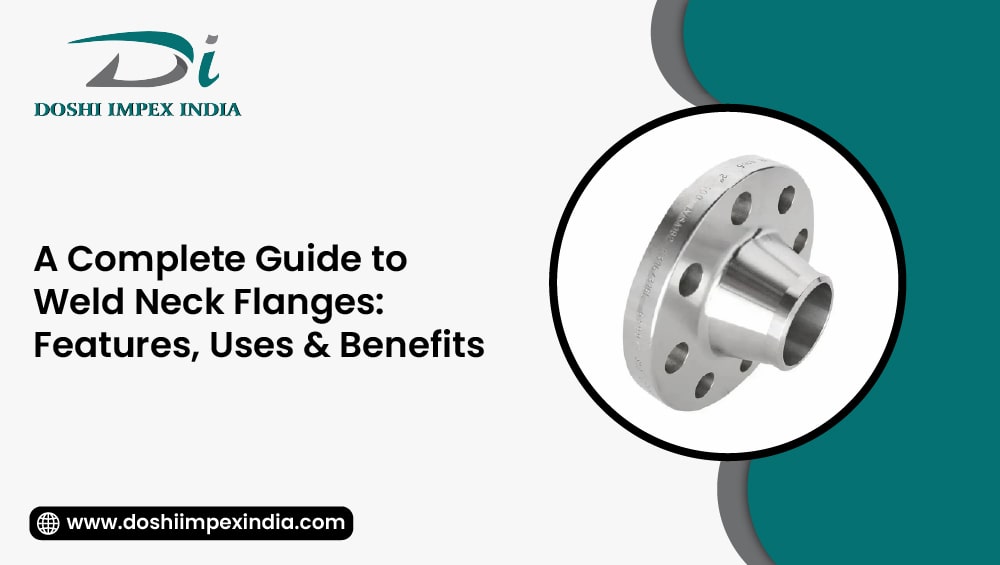
In piping systems across the oil & gas, petrochemical, and power generation industries, as well as many other industrial sectors, weld neck flanges are among the most preferred types of flange connections for high-stress, high-pressure, and high-temperature applications. Their unique geometry, skill to transfer stress easily into the pipe, and robustness make them ideal for critical pipe joints. Doshi Impex India is a renowned weld neck flange supplier, and in this guide, we’ll explore what weld neck flanges are, their key functions, applications, improvements, and key considerations.
What Is a Weld Neck Flange?
A weld neck flange, over and above that known as a welding neck flange, is a flange with a long tapered hub that comfortably converts into the pipe or accurately to which it is welded. Because of this taper, stress is distributed over a more extensive area, reducing concentrations at the flange-to-pipe junction.
The end of the pipe (or fitting) is inserted into the bore of the flange and joined by a full-penetration butt weld (groove weld), often graded to deal with severe service.
Weld neck flanges are manufactured from forgings or solid components and come in various pressure classes, face types (raised face, flat face, ring-type joint), and sizes (e.g., per ASME B16.5 for NPS ½″–24″ or ASME B16.47 for more expansive flanges).
Key Attributes & Design Attributes
Here are the pivotal attributes and design elements of weld neck flanges:
- Long Tapered Hub
The hub has a steady taper, thickening toward the flange face. This design transfers stresses into the pipe gradually, reducing sudden stress concentrations and upgrading fatigue life.
- Full Penetration Butt Weld Connection
Because the flange is welded by a groove weld around its full circumference, a strong and integral connection is formed, fitting for high pressure, temperature, and dynamic controls.
- Matched Bore / Smooth Flow Path
The bore is machined to match the internal diameter (ID) of the pipe, preventing unpredictable revisions in flow area, reducing turbulence, pressure drop, and erosion.
- Face Types & Gasket Surfaces
Weld neck flanges are offered with different face types such as raised face (RF), flat face (FF), or ring-type joint (RTJ). The choice depends on sealing obstacles and service requirements.
- Dimensioning & Standards Obedience
The geometry (hub length, thickness, bore, bolt holes, outer diameter) is determined by standards like ASME B16.5 (for flanges up to 24″) and B16.47 (for more expansive sizes).
- Material Options
Weld neck flanges come in a wide range of items: carbon steel (ASTM A105), stainless steel (304, 316, 316L), alloy steels, duplex and alternative corrosion-resistant alloys, nickel alloys, etc., depending on service conditions.
Uses & Applications in Pipe Systems
Weld neck flanges are generally used in critical services and demanding pipeline networks. Some usual pipe joint and pipeline applications include:
High-pressure pipelines in oil & gas, refineries, petrochemical plants, where pressures are often high and truthfulness is necessary.
High-temperature service, such as steam lines, heater tubes, boiler contacts, where the elements must withstand thermal cycling. The integral weld and steady hub help with thermal stress.
Cryogenic or low-temperature systems, where weld integrity and material toughness are essential.
Offshore and subsea pipelines, where corrosion resistance, mechanical integrity, and long-term exactness are key.
Pressure vessels and nozzle contacts, using long weld neck flanges or nozzle extensions. The extended neck provides support and stress distribution.
Chemical processing plants, where corrosive fluids, frequent thermal cycles, or corrosive limitations demand durable flange contacts.
Potentiality plants/utility piping systems, where high pressure and temperature demands are standard.
In per of these cases, the weld neck flange serves as a reliable flange connection, offering capital, integrity, and minimal flow disruption.
Gains & Advantages of Weld Neck Flanges
Let’s highlight the important advantages of this flange type:
- High Mechanical Capital & Integrity
Because the flange is butt-welded with full penetration and its hub shifts stress-relaxingly, weld neck flanges are robust under high pressure and drastic service.
- Reduced Stress Dedication
The tapered hub ensures that loads (internal pressure, flexing, thermal growth) are spread over a more extensive area, reducing peak stresses at the weld junction.
- Terrific Flow Characteristics & Minimum Turbulence
Because the bore is matched to the pipe ID and the transition is smooth, flow disruption is minimal, reducing diminution, pressure drop, or turbulence.
- Leak-Resistant, Reliable Seal
The integral weld joint and valid flange/gasket sealing make weld neck flanges too leak-resistant under severe rules.
- Refined Fatigue & Dynamic Performance
For systems vulnerable to cyclic loads, pulsation, vibration, or thermal cycling, the stress distribution and robust weld provide refined fatigue life versus flanges with weaker welds or unpredictable changes.
- Suitability for Severe Requirements
They are often used in “fuming environments” — severe temperature, pressure, corrosive media — thanks to their inherent structural sturdiness. Weld neck flanges have been used in pressures up to 5,000 psi in practice.
- Effortlessness of Inspection & Testing
The weld region and flange faces are obtainable for radiography, non-destructive testing, and adjustment checks, providing rightness reassurance.
- Wide Presence & Standardization
Weld neck flanges comply with recognized standards (ASME, ANSI, DIN, ISO), so compatibility and interchangeability are well defined.
- Long Life
Because they deal with stress well and keep away from startling adjustments, they last longer and require less maintenance than weaker flange types under heavy service.
- Versatility of Items
They can be formed in
- Carbon steel
- Stainless steel
- Duplex, nickel alloys, etc., which gives flexibility in matching the service fluid and locale.
Design Issues & Limitations
Equal yet weld neck flanges are robust; a few concerns and trade-offs must be taken into account:
Higher Cost / Skilled Welding Vital
Fabricating a weld neck flange connection (groove weld, organization, inspection) requires skilled welders and more hard work than simpler flanges (e.g., slip-on).
Not ideal for systems that require frequent disassembly.
Because the flange is welded integrally, disassembly or replacement may require cutting or sizeable rework.
Longer Lead Moment
Particularly for comprehensive sizes or different materials, the manufacturing and machining of weld neck flanges may take longer.
Need for Clear Harmony
Misalignment comparing the pipe and flange can
- Induce stress
- Weld defects
Therefore, careful layout and fixturing are necessary.
Weld Inspection & Quality Control
The weld is a critical junction, so non-destructive testing (e.g., radiography, ultrasonic) is often mandatory, adding cost and quality demands.
Thermal Amplification & Movement
The flange and piping system must provide an opportunity for thermal proliferation; mooring and guide design must consider how factors will distribute through the flange joint.
Despite these restrictions, for many critical systems, the improvements of a weld neck flange outweigh the disadvantages.
Arrangement & Specification Parameters
When choosing or specifying a weld neck flange for a pipe joint, consider these key factors as per Doshi Impex India experts:
- Pressure Class / Rating
Match the flange class like
- 150
- 300
- 600
- 900
- 1500
- 2500
This is important to design appropriate pressure and service conditions.
- Material & Metallurgy
Make a decision on a flange material compatible with
- Pipe
- Fluid
- Corrosion
- Atmosphere
- Temperature range
- Face Type & Gasket
Decide whether raised face (RF), flat face (FF), or ring-type joint (RTJ) is relevant for sealing under controls (pressure, temperature, cyclic load).
- Dimensioning / Standard Obedience
Use the standard flange measurements in
- Bolt circle
- Thickness
- Bore
- Hub lengths)
This should be as specified in ASME B16.5 or B16.47.
- Weld Procedure & Filler Material
Use the exact welding procedure (WPS), chosen filler metal, and preheat/post-weld heat treatment if needed to
- Guarantee weld integrity
- Prevent undue residual stress.
- Inspection & Testing
Plan for NDT (radiography, ultrasonic) of the weld, hydrostatic testing, flange face checks, and harmony checks.
- Quota for Thermal & Mechanical Loads
Consider outermost loads, vibrations, spread pressures, and design anchors or guides to manage them.
- Lifecycle & Maintenance Access
Factor in how painless it will become to inspect, repair, or replace the flange in service.
FAQs
- Why make a choice of weld neck flanges over slip-on or socket weld flanges?
Weld neck flanges offer excellent mechanical strength, better distribution of stress, and a smoother flow path due to their matched bore and taper hub. These elements make them well-suited for high-pressure applications and demanding service, unlike slip-on or socket weld flanges, which rely on fillet welds and have less capital.
- What are the limits of pressure and temperature for weld neck flanges?
While limits have faith in flange class and material, weld neck flanges have been used in pressures up to 5,000 psi in some instances (largely in robust supplies) ([Wikipedia][1]) and are commonly employed in high-pressure, high-temperature environments due to their structural integrity.
- Can a weld neck flange be used on a pipe with a different diameter?
Yes, in special cases, one can use a reducing weld neck flange, where the hub shifts from a wide-ranging flange bore to a smaller pipe bore. Despite that, the geometry and stress handling must become attentively scrutinized.
- How critical is weld quality and inspection for weld neck flange joints?
It is very critical because the weld is integral to
- Strength
- Integrity
- non-destructive testing (radiography, ultrasonic)
It is often essential to
- Ensure full penetration
- Detect defects.
Poor welds can lead to
- Cracks
- Leakage
- Ruinous failure.
- Are weld neck flanges simple to maintain or replace?
Not constantly. Because they are welded all the time, removal typically requires cutting or substantial work. As a result, they are less ideal for systems needing frequent disassembly. Strategizing maintenance access and replacement procedures is critical upfront.