


 Call +91 9833907060
 Send E-mail
In industrial pipeline systems, fittings for pipes play an important role in making sure that flow distribution is smooth, as well as in pressure management and the efficiency of the system. One of the most frequently utilized fittings is the equal Tee and Reducing Tee fittings. These fittings are crucial for industries like oil and gas as well as power plants, petrochemicals, pharmaceuticals, water treatment, and construction.
Understanding the distinction in Equal Tee and. The reduction of Tee aids contractors, engineers, and buyers in picking the appropriate fitting for their pipe applications. In this article, we at Doshi Impex India look at their designs, functions, and advantages, as well as their applications and the main elements to be considered when making a decision between the two.
What is an Equal Tee?
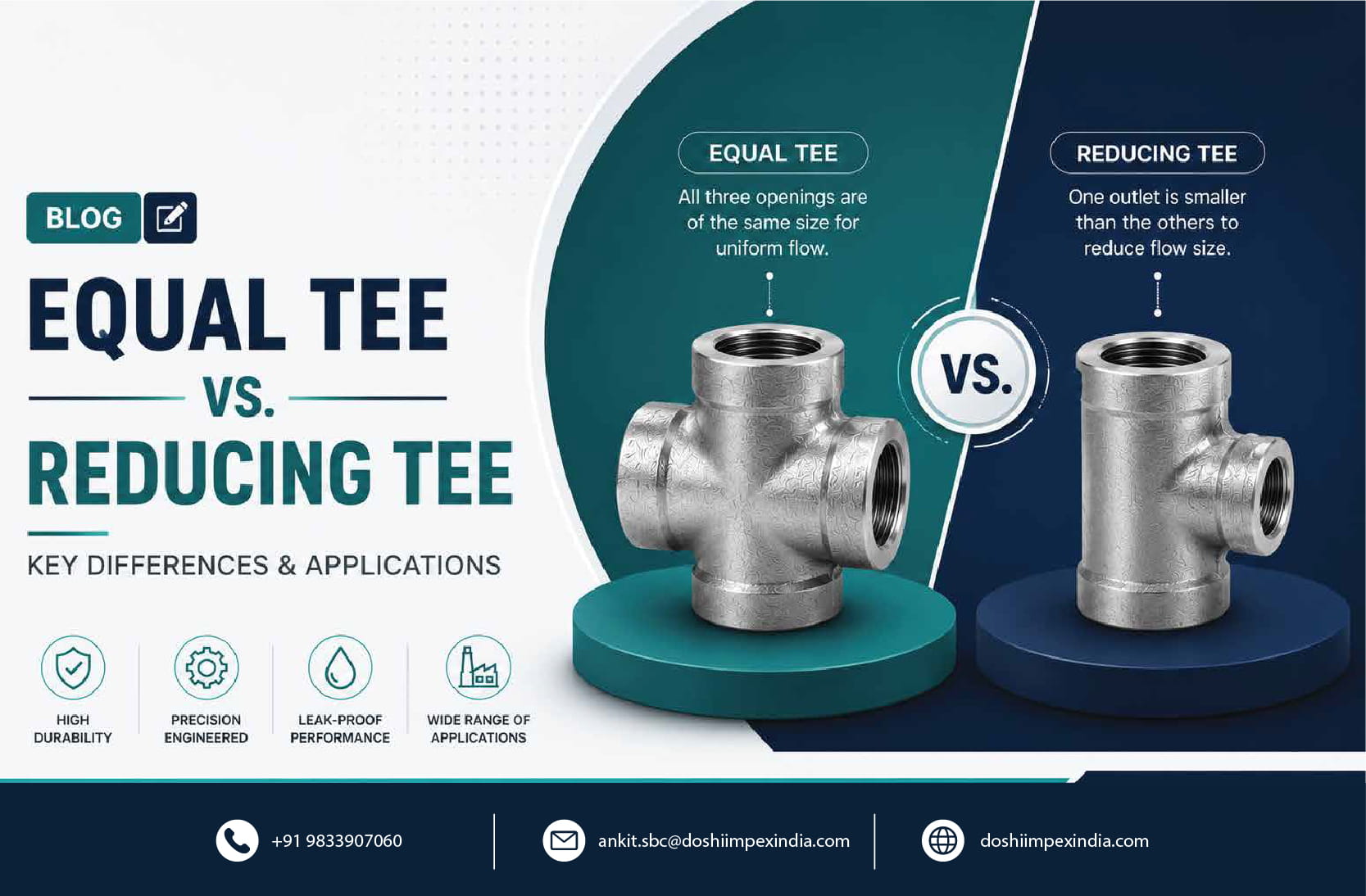
Equal Tee is a fitting for pipes that has three openings of the same size. It is constructed with the shape of the letters “T” as well. It is employed to split or blend the flow of fluid in a pipeline.
The equal tee fitting permits fluid to flow in three directions, while keeping the same-sized pipe through the connection.
Features of Equal Tee
- Each end has the same dimensions.
- It ensures an even flow distribution
- There are a variety of materials available, including stainless steel, carbon steel, duplex steel, and alloy steel
- Ideal for high-temperature and high-pressure applications
- Often used in balanced pipe systems
Benefits of Equal Tee
- Simple installation and maintenance
- Cost-effective for typical pipe systems
- Provides smooth fluid distribution
- Reduces turbulence for pipelines of equal size
- Durable and resistant to corrosion
What is a Reducing Tee?
The Reduced Tee is a fitting for pipes that has a branch opening that is smaller than that of the primary run. It is employed when a pipeline requires branching into a smaller-sized pipe.
The reduced tee fitting is perfect for systems that require flow to be diverted to a smaller area without requiring other connectors or reducers.
Features of Reducing Tee
- The main branch and the main pipeline have different diameters
- Design compact and space-saving
- Available in welded and seamless construction
- Ideal for applications requiring pressure regulation.
- Aids in optimizing the flow of fluids
Benefits of Reducing Tee
- Reduces the requirement for additional fittings
- Improves flow control
- Space saved for installation
- Minimizes pressure drop
- Enhances system efficiency
Equal Tee Reduced Tee Major Differentialities
While both fittings are used for branches, there are some significant distinctions between the two.
1. Size Configuration
The most important difference is the dimension that the branch connects.
- Equal Tee: Each opening is identical in size.
- Reducing the Tee Branch opening is less than the main pipe.
For instance:
- Equal Tee: 4″ x 4″ x 4″
- Reducing Tee: 6″ x 6″ x 4″
2. Flow Distribution
Equal tees distribute the flow equally across all directions, and reducing tees control can restrict the flow to smaller branch lines.
- Equal Tee Equal Tee: Balanced flow
- Reducing Tee: Managed or reduced flow
3. Application Purpose
Equal tees can be used for the case where the same pipe diameter is required across the entire system, whereas reducing or equal tees are utilized for branching to smaller pipes.
4. Installation Requirements
Reduced tees eliminate the requirement of separate reducers. This makes installation less bulky and more efficient.
Tees with equal lengths are more simple and frequently used in standard layouts.
5. Pressure Handling
Both fittings are made to be used in high-pressure systems. However, reduction tees are particularly beneficial when flow control and pressure reduction are required.
Applications of Equal Tee
Equal tee fittings are commonly used in the industries in which uniform flow distribution is essential.
Oil and Gas Industry
Pipelines are pipelines used to transport natural gas, crude oil along with petroleum and other products.
Chemical Processing Plants
Helps distribute chemicals evenly over various processing units. Helps distribute chemicals evenly across different processing.
Water Treatment Plants
In drainage and water supply systems to ensure a balanced flow of fluid.
Food and Beverage Industry
Ideal for hygienic systems that require an equal flow distribution.
HVAC Systems
They are used for heating, ventilation and air conditioning pipelines.
Applications of Reducing Tee
The reduction of tees is essential for pipelines in areas where sizes are subject to change.
Petrochemical Industry
It is used to connect branch lines to larger processing systems.
Power Plants
Helps control steam and water flow in pipelines of different dimensions.
Pharmaceutical Industry
Pipelines used in process systems that require precise flow control.
Fire Protection Systems
Usually, they are used in sprinkler systems in which smaller branch connections are required.
Marine and Shipbuilding
Utilized in piping layouts that are compact to reduce space and increase efficiency.
Materials Used for Equal and Reducing Tees
Equal tees as well as reducing Tees are offered in various materials, based on the setting.
Stainless Steel Tee Fittings
- Excellent corrosion resistance
- Ideal for marine and chemical applications
Carbon Steel Tee Fittings
- Durability and strength are high.
- Perfect for high-pressure and industrial systems. Ideal for industrial and high-pressure
Duplex Steel Tee Fittings
- Superior resistance to cracking caused by stress corrosion
- Widely employed in offshore applications
Alloy Steel Tee Fittings
- Resistance to high temperatures
- Ideal for power plants and refineries
How to Choose Between an Equal Tee and a Reducing Tee?
Pipeline Design
Select an equal tee if all pipelines connecting are the same size. Make use of a reducing tee when connecting to a smaller line.
Flow Requirements
To distribute flow evenly, equally sized tees work best. To control or limit flow, reducing tees can be the best option.
Space Availability
The reduction of tees helps save installation space by removing the need for additional reducers.
Pressure and Temperature Conditions
Make sure the material used for fitting and the pressure rating are in line with the operational conditions.
Industry Standards
Make sure to select fittings that are manufactured in accordance with ASTM, ASME, ANSI or DIN standards to ensure reliability and security.
Equal Tee as compared to. Reduced Tee: Which one is better?
There isn’t a single “better” alternative because each fitting serves a different purpose.
- Select the Equal Tee to create balanced flow systems that use identical pipe sizes.
- Select the reduction Tee for connecting pipes of different sizes or controlling the flow through branches.
The proper selection can improve the efficiency of the pipeline, reduce the cost of maintenance, and increase the efficiency of operations.
Understanding the distinctions between Equal Tee and cutting Tee is vital to designing effective and reliable pipeline systems. Equal tees are ideal to connect pipelines of equal size as well as balanced distribution of flow, while reducing tees are intended to connect branch lines with smaller diameters and maximize the flow control.
The fittings are extensively used in a variety of industries, including oil and gas, pharmaceuticals, petrochemicals, water treatment, and even power generation. By choosing the correct fitting for the job based on specifications, pressure conditions, and pipeline design, companies can be sure of smooth operation, safety, and long-term reliability.
It doesn’t matter if you require stainless steel Tee fittings, carbon-steel reduced tees, or steel equal tees; selecting the highest-quality fittings for your pipes from reputable manufacturers like Doshi Impex India is vital to ensure the best performance of your system. Get in Touch with us today.
1. What is the primary differentiator between an Equal Tee and a Reducing Tee?
The primary distinction is that a similar tee is equipped with all three openings of the identical dimensions, whereas a smaller Tee has a smaller branch opening in comparison to that of the primary pipeline.
2. Where are fittings for reducing tees most often employed?
Reduced tee fittings are typically used in petrochemical plants, power plants, fire safety systems, and industrial piping systems in which smaller branch connections that are smaller are required.
3. What is the best material for fittings on tees?
The ideal material will depend on the use. Steel is ideal for resistance to corrosion, carbon steel increases strength, and duplex steel is ideal for tough offshore environments.
4. Do Equal Tee or Reducing Tee offer a variety of pressure ratings?
Both fittings can be found in various pressure ratings and standards like ASME, ASTM, and ANSI to fit various industrial needs.
5. Why do t-shirts with fewer tees get the preference in piping systems with compact dimensions?
Reduced tees remove the requirement of separate reducers, which saves installation space and increases piping system efficiency.