


 Call +91 9833907060
 Send E-mail
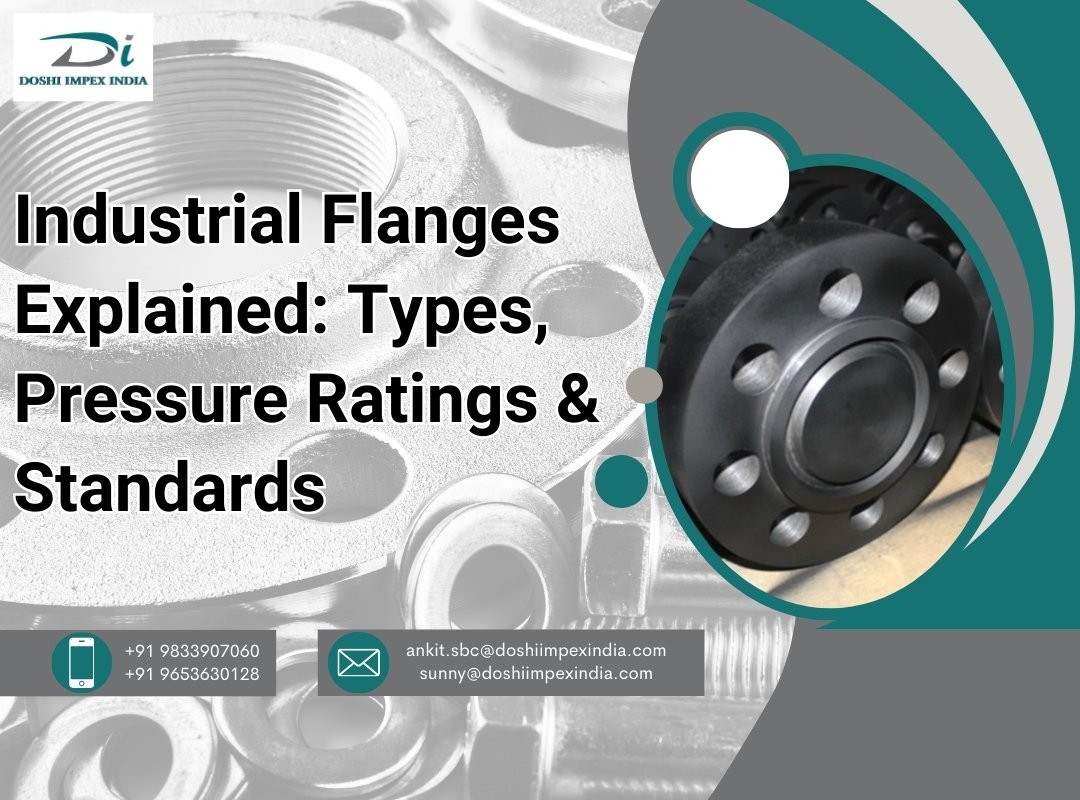
In industries that use pipelines to transport gases, fluids, steam, chemicals, or other substances, industrial flanges play an essential role in ensuring security and strength, as well as leak-proofing connections. Beginning with the Oil & Gas Industry, petrochemicals to power water treatment plants and power plants, flanges are essential in facilitating the assembly and inspection, maintenance,e and repair of piping systems.
We are Doshi Impex India, a leading Industrial Flanges Supplier in India, and have created this blog that explains everything you must learn about industrial Flanges. This includes information about their designs as well as pressure ratings, along with international norms. The purpose of this blog is to help engineers, as well as procurement managers and project managers, choose the appropriate fitting flange for the job.
What are industrial flanges?
Industrial flanges are mechanical parts that connect pipes and valves, pumps, and other components in the pipeline system. They are typically joined using bolts and then sealed with gaskets to avoid leaks. In contrast to welded joints, flanged connections permit easy removal and are ideal for use in systems requiring regular maintenance or a thorough inspection.
Important Benefits of Industrial Flanges
- Simple installation and removal
- Pipe connections that are strong and reliable.
- It is suitable for high-temperature and high-pressure applications
- Compatible with various Materials for piping
Different types of industrial flanges
Knowing the different kinds of flanges is the first step towards selecting the best solution for the industrial application.
1. Weld Neck Flanges
Weld neck flanges are made to be used in high-temperature and high-pressure applications. Their tapered hubs long provide great stress distribution and is ideal for essential services in the chemical and oil & gas industries.
Ideal for high-pressure pipelines Critical applications
2. Slip-On Flanges
Slip-on flanges slide on top of the pipe and are then welded both from the inside and outside. They are simpler to align and set up compared to flanges for welding necks.
Recommended for: Medium to low-pressure systems.
3. Blind Flanges
Blind flanges can be used to finish the pipe and piping system. They are often employed for pressure testing and future expansion of pipe systems.
Best for: Pipeline termination, inspection points
4. Threaded Flanges
Threaded flanges connect to pipes with threads, instead of welding. They are useful in situations in which welding is not an option.
Ideal for low-pressure Non-critical systems.
5. Lap Joint Flanges
Lap joint flanges are used with stub ends and are favored for areas where frequent dismantling is necessary. They can be positioned with ease.
The best choice is for systems that require regular maintenance
Understanding the Pressure Ratings of Flanges
Pressure ratings show the maximum pressure the flange will withstand at a particular temperature. The selection of the right flange pressure class is essential to ensure safety and efficiency.
Common Flange Pressure Classifications
- Class 150 – Industrial low-pressure use
- Class 300 Applications with medium pressure
- Class 600 High-Pressure Systems
- Class 900, 1500, and 2500: Extremely high temperature and pressure environments
Pressure ratings decrease when temperatures rise, so be aware of operating conditions when selecting Flanges.
Industrial Flange Standards Explained
Flanges are made according to international standards to guarantee compatibility with safety, quality, and performance. Selecting the right flange type will ensure seamless integration with existing systems of piping.
Commonly used Flange Standards are commonly used.
- ASME and ANSI Standards – Widely used in the oil and gas, petrochemical, and power industries
- DIN Standards – Common in European and international projects
- BS Standards – British-origin standards widely used
- IS Standards – Indian Standards that are suitable for domestic projects
Each standard specifies dimensions of tolerances, pressure classes, and also the material to ensure uniform performance.
Materials used in Industrial Flanges
The material selection has a direct impact on performance and durability. Materials that are commonly used include:
- Carbon Steel Flanges are cost-effective and widely utilized
- Stainless Steel Flanges are corrosion-resistant and suitable for the food and chemical industries
- Alloy steel flanges are perfect for high-temperature and high-pressure applications
Doshi Impex India Doshi Impex India, flanges are manufactured and shipped in the form of materials that satisfy international quality standards and specifications for projects.
What is the best way to choose the right Industrial Flange?
When choosing industrial flanges, be aware of the following aspects:
- Operating Pressure and Temperature
- The type of gas or fluid that you are using
- Piping Material Compatibility
- Industry Standards that are applicable
- Inspection and Maintenance Requirements
The wrong choice of flange could cause leakage, disruption, or even safety risks, making an expert’s advice essential.
Why choose Doshi Impex India for Industrial Flanges?
Doshi Impex India is a well-known industrial flanges supplier catering to a variety of industries throughout India as well as global markets.
What makes them different:
- The flanges are of various types and different pressure ratings
- International standards are met.
- Reliable and consistent quality
- The time-to-delivery of industrial projects is critical.
If you require flanges for power plants, refineries, or industrial pipe systems, Doshi Impex India guarantees the highest quality that you can count on.
Industrial flanges go beyond just connectors. They are vital components that ensure the safety of pipes. Knowing the various types of industrial flanges, pressure ratings, and standards helps buyers and engineers make educated choices that enhance efficiency and lower long-term costs.
For premium, standards-compliant, and high-quality industrial flanges, Doshi Impex India remains a reliable supplier of industrial infrastructure and pipe solutions.