


 Call +91 9833907060
 Send E-mail
In industrial piping systems, every connection matters. A pipeline may transport water, steam, oil, gas, or process fluids, but its reliability often depends on the quality of the fittings connecting individual pipe sections. For applications requiring compact dimensions, strong connections, and dependable performance, socket-weld pipe fittings have become a practical choice across several industries.
For industrial buyers searching for a socket-weld pipe fittings supplier in Titagarh, understanding where these fittings work best and why they are preferred can simplify purchasing decisions. At Doshi Impex India, we believe that selecting the right piping component is not simply about finding a product at the right price. It is about understanding operating conditions, pressure requirements, material compatibility, and long-term performance.
What Are Socket-Weld Pipe Fittings?
Socket-weld pipe fittings are components designed to connect pipes by inserting the pipe end into a recessed socket within the fitting. A fillet weld is then applied around the joint to create a permanent connection.
Unlike butt-weld fittings, which generally require the pipe and fitting ends to be prepared and aligned for welding, socket-weld fittings feature a socket that helps position the pipe before welding.
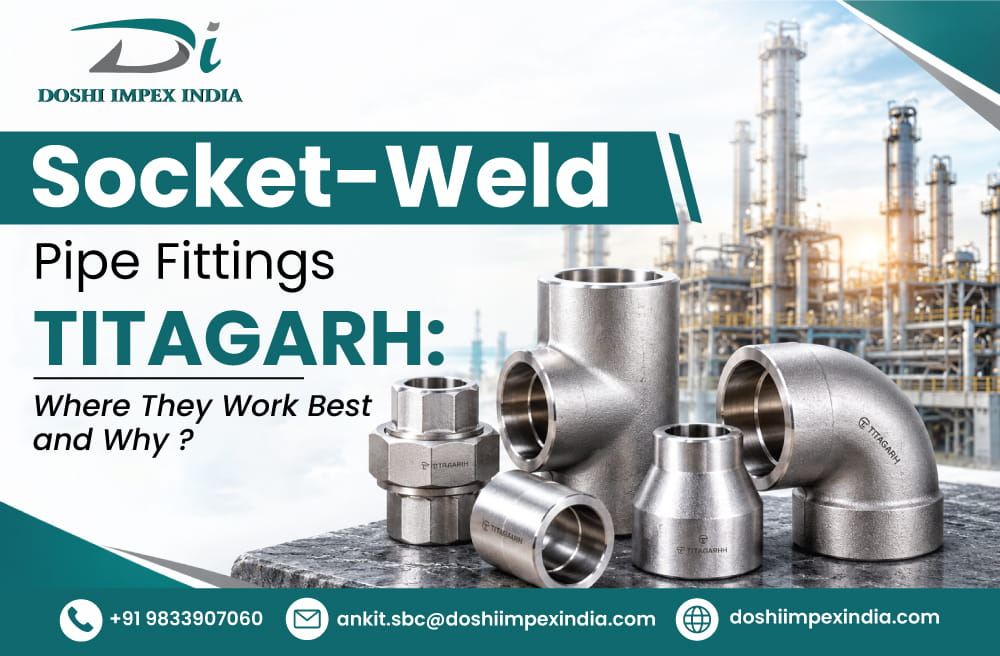
Common socket-weld pipe fittings include elbows, tees, couplings, reducers, and caps. These components help engineers change pipeline direction, create branch connections, join pipe sections, reduce pipe sizes, and close pipeline ends.
For buyers exploring socket-weld pipe fittings in Titagarh, the main consideration is whether this connection method suits the pipeline’s size, pressure, fluid, and operating environment.
Where Do Socket-Weld Pipe Fittings Work Best?
1. High-Pressure Industrial Piping Systems
One of the principal applications of socket-weld pipe fittings is small-bore piping designed for demanding pressure conditions. Depending on the material, pressure class, design code, and installation quality, these fittings can be suitable for high-pressure industrial services.
They are commonly considered for auxiliary piping, hydraulic systems, instrumentation connections, and selected process lines.
However, pressure suitability should never be determined by appearance alone. Engineers must verify the fitting’s pressure rating, temperature limits, material specification, and applicable piping code before installation.
When sourcing socket-weld pipe fittings in Titagarh, industrial buyers should confirm that the selected components meet the project’s technical specifications.
2. Chemical and Process Industries
Chemical processing facilities often require piping components that can withstand particular chemicals, temperature variations, and operating pressures. Socket-weld fittings manufactured from suitable stainless steel, carbon steel, or alloy materials may serve these applications.
For example, stainless steel fittings may be appropriate for certain corrosive environments, while carbon steel fittings can be suitable for compatible non-corrosive or appropriately controlled services.
The critical factor is material compatibility. Not every stainless steel or alloy grade performs equally well in every chemical environment.
At Doshi Impex India, we recommend that buyers evaluate the fluid composition, concentration, temperature, and operating conditions before selecting fittings for chemical process applications.
3. Power Plants and Utility Pipelines
Power generation facilities use extensive piping networks for auxiliary services, instrumentation, and other utility applications. In suitable small-bore systems, socket-weld elbows, tees, and couplings can help create compact connections.
Their socket configuration can simplify pipe positioning during assembly, particularly where several short pipe sections and fittings must be connected within a limited space.
Nevertheless, applications involving thermal cycling, vibration, severe service conditions, or critical steam lines require careful engineering assessment. Socket-weld fittings should only be used where the applicable design code and project specifications permit them.
4. Oil, Gas, and Hydraulic Applications
Oil and gas facilities frequently incorporate small-bore piping for instrumentation, control systems, and selected auxiliary services. Hydraulic equipment may also use welded piping connections where the system design calls for them.
Socket-weld fittings can offer a compact, permanent joint in suitable applications. Their usefulness depends on the required pressure rating, fluid compatibility, inspection requirements, and installation standards.
For buyers searching for socket-weld pipe fittings in Titagarh, identifying the intended application before requesting a quotation helps narrow down the correct fitting type and material grade.
Why Choose Socket-Weld Pipe Fittings?
Several practical advantages make socket-weld fittings worth considering for suitable industrial installations.
Compact construction: Their design can be useful where space is limited and threaded connections are unsuitable.
Convenient alignment: The socket helps position the pipe before welding, supporting assembly in small-bore piping systems.
Permanent welded joints: Properly designed and executed welds provide a permanent connection without relying on threaded engagement.
Versatile configurations: Elbows, tees, couplings, reducers, and caps accommodate different piping layouts.
Availability in different materials and pressure classes: Depending on the manufacturer and specification, buyers can select products suited to different operating requirements.
These advantages do not eliminate the need for quality control. Correct pipe insertion, specified root clearance, qualified welding procedures, suitable weld inspection, and compliance with the applicable code remain essential.
How to Select the Right Socket-Weld Pipe Fittings in Titagarh
Choosing a supplier requires more than comparing product photographs or headline prices. Industrial buyers should follow a structured evaluation process.
First, confirm the dimensions. Check nominal pipe size, fitting type, schedule compatibility, and the relevant dimensional standard.
Second, verify the material grade. Carbon steel, stainless steel, and alloy steel have different mechanical and corrosion-resistance properties. The correct selection depends on the service environment.
Third, check the pressure class. Socket-weld fittings are available in different pressure classes, but the actual allowable operating conditions depend on the governing standard, material, temperature, and system design.
Fourth, review applicable standards. Specifications such as ASME B16.11 are commonly used for forged socket-welding fittings. Buyers should verify the exact standard and any additional project requirements before ordering.
Finally, assess documentation and supply reliability. Material test certificates, traceability, dimensional conformity, inspection records, and delivery commitments can be important considerations for industrial procurement.
When comparing socket-weld pipe fittings in Titagarh, these checks help buyers make decisions based on technical suitability and lifecycle value rather than price alone.
Why Consider Doshi Impex India?
At Doshi Impex India, industrial procurement begins with understanding what the application demands. A fitting intended for an instrumentation line may have different requirements from one specified for a chemical processing unit or a power plant utility system.
Our product sourcing approach focuses on helping buyers identify suitable piping components according to their stated requirements. Customers can enquire about fitting types, sizes, material specifications, pressure classes, and applicable standards to establish whether a product matches their project needs.
For buyers seeking Premium Quality Socket-weld pipe fittings in Titagarh and surrounding industrial areas, a clear enquiry containing the required dimensions, material grade, quantity, and technical specifications can make the quotation process more efficient.
The objective is straightforward: help industrial buyers evaluate the right product for the right application while keeping quality, documentation, and supply requirements in focus.
Socket-weld pipe fittings offer a practical connection solution for suitable small-bore industrial piping systems. Their compact design, convenient alignment, and permanent welded joints make them useful in selected applications across chemical processing, power generation, hydraulic systems, and industrial utilities.
However, successful performance depends on choosing the correct material, pressure class, dimensions, and installation procedure.
For businesses searching for Socket-weld pipe fittings in Titagarh, Doshi Impex India encourages a specification-first approach. When buyers understand their application requirements and verify product conformity before ordering, they can make more informed procurement decisions and build piping systems designed for dependable service.
Frequently Asked Questions (FAQs)
1. What are socket-weld pipe fittings used for?
Socket-weld pipe fittings connect pipes in suitable small-bore piping systems. They are used in selected high-pressure auxiliary lines, instrumentation systems, hydraulic applications, chemical processing facilities, and industrial utilities, subject to applicable design requirements.
2. Where can buyers source socket-weld pipe fittings in Titagarh?
Industrial buyers can contact Doshi Impex India to enquire about socket-weld pipe fittings for their projects. Availability, sizes, material grades, pressure classes, and delivery schedules should be confirmed against the required specifications.
3. Which materials are available for socket-weld pipe fittings?
Depending on the product range, socket-weld fittings may be manufactured from carbon steel, stainless steel, and various alloy steels. Material selection should be based on operating temperature, pressure, fluid compatibility, corrosion exposure, and project standards.
4. Are socket-weld pipe fittings suitable for high-pressure applications?
Yes, socket-weld fittings can be suitable for certain high-pressure applications when the selected fitting, material, and installation comply with the applicable design code. Engineers must verify the pressure-temperature requirements and service conditions before approving their use.
5. What should buyers check before purchasing socket-weld pipe fittings in Titagarh?
Buyers should verify fitting dimensions, nominal pipe size, material grade, pressure class, applicable standards, inspection requirements, material test certificates, and supplier delivery commitments. These checks help establish product suitability before an order is placed.