


 Call +91 9833907060
 Send E-mail
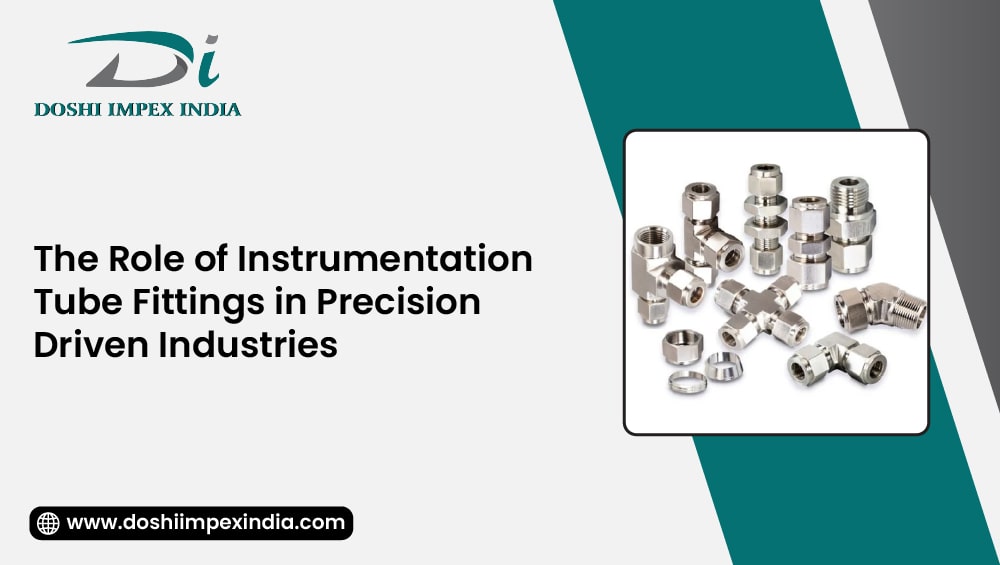
The Role of Instrumentation Tube Fittings in Precision-Driven Industries
Instrumentation tube fittings are a vital element in various industries that require precise control over gases and fluids. Instrumentation fittings provide leak-tight interconnections and accurate measurements in demanding environments. They preserve system integrity, avoid contamination, and enable effective operations in industries including oil and gas, pharmaceuticals, and semiconductor production. Doshi Impex India is one of the suppliers of SS instrumentation fittings in India and all over the world. We also provide fittings of various other materials. We have created this write-up based on our expertise and experience in this field, so that you can understand the role of tube and instrumentation pipe fittings.
What are instrumentation tube fittings?
Manufacturers of Instrumentation tube fittings produce them in a precise way to play the role of connectors that fulfill the following functions:
- Join the flow of fluids
- Terminate the fluid’s flow
- Regulate the flow of fluid or gas.
Which industries utilize instrumentation tube fittings?
Instrumentation fittings are very important for those sectors wherein leak-free and high-pressure performance is crucial. Some of these industries are as follows:
- Oil and gas
- Petrochemicals
- Power plants
- Pharmaceuticals
- Maritime engineering
What are the common types of instrumentation tube fittings?
1. Fittings for Compression
When an engineer tightens the nut, the technician uses one or two ferrules to hold onto and seal the tube. The important characteristics of the compression instrumentation fittings are as follows:
- Easy to install without welding
- Vibration-resistant
- Leak-tight.
2. Fittings for a Single Ferrule
This type of instrumentation fitting possesses a single ferrule that grabs and seals the tube. Its key feature is that it offers good sealing performance with a simpler design than double ferrules. They are typically used in many low- to medium-pressure systems.
3. Fittings for Double Ferrules
The double-ferrule stainless steel instrumentation fittings and those of other materials use a back ferrule to hold the tube and a front ferrule to seal. Its main highlights are that they are preferred in critical instrumentation lines because of the following reasons:
- Excellent resilience to high pressures
- Brilliant capacity to withstand vibrations.
Its common uses are as follows:
- Power generating
- Chemical facilities
- Oil and gas.
4. Flare Fittings
The process of creating a seal involves clamping the tube end with a nut and sleeve after flaring it, usually at 37° or 45°. The important characteristic of this fitting is that it ensures that the hydraulic and high-pressure fuel systems are. These fittings are commonly applied in:
- Marine
- Automotive and aerospace instruments.
5. Fittings for Pipe Thread (NPT, BSPT, BSPP)
They convert instrumentation tubes to systems that use threaded pipes. Their most important features are that they:
- Stop leaks
- Use PTFE tape
- Make use of thread sealant
The common applications of pipe thread fittings are as follows:
- Transitions
- Adapters
- Process linkages
6. Fittings with Quick-Connect (Push-to-Connect)
These instrumentation fittings enable quick tube connections and disconnections without the need for tools. It is convenient for lines that are temporarily or frequently altered.
7. Fittings for Bulkheads
It allows tubing to pass through a wall or panel while providing a leak-proof seal. One of its main functions is to support clean, orderly tube layouts.
8. Elbows, Tees, and Cross Fittings
These fittings route tubing at different angles and maintain flow paths without kinking tubing.
| Type | Function |
| Compression Fittings | Create a seal by compressing ferrules onto tubing. |
| Ferrule Fittings | Use one or two ferrules to grip and seal the tube. |
| Flare Fittings | Seal by flaring the tube end to fit the connector. |
| Pipe Fittings | Adapt tube connections to threaded pipe ends. |
| Quick-Connect Fittings | Allow rapid connection/disconnection without tools. |
What are the advantages and disadvantages of instrumentation tube fittings?
1. Compression Fittings
Advantages:
- Effortless to install without welding or soldering.
- It can be disassembled and reused.
- Usable for both metal and plastic tubing.
Disadvantages:
- Not as strong under excessive vibration as double ferrule designs.
- Requires proper torque to skip leaks.
2. Single Ferrule Fittings
Advantages
- Ordinary design and lower cost.
- Helpful for moderate pressure and vibration.
Limitations
- Less vibration resistance than the double ferrule.
- It may require more maintenance in high-pressure lines.
3. Double Ferrule Fittings
Advantages:
- Finest vibration resistance.
- Superb sealing under high pressure.
- Reduces tube deformation for simpler reassembly.
Restrictions:
- Higher cost
- More authenticity is needed.
4. Flare Fittings
Advantages:
- Strong mechanical connection.
- Favorable for high pressure and temperature extremes.
Limitations:
- Requires special flaring tools.
- Tube end should be perfect.
5. Pipe Thread Fittings (NPT, BSPT, BSPP)
Advantages:
- Smooth to change between tubing and threaded pipe systems.
- Available easily
Limitations
- Tapered threads require sealant (PTFE tape or paste).
- Threads can wear out from repeated organization.
6. Speedy-Connect (Push-to-Connect) Fittings
Advantages:
- Instant installation and removal without tools.
- Reduces downtime in changeable systems.
Negative Conditions:
- Lower-pressure technique than ferrule fittings.
- Seal items may limit chemical compatibility.
7. Bulkhead Fittings
Advantages:
- Neat tubing layout.
- Prevents tube burden from passing through surrounding walls.
Obstacles:
- Requires appropriate hole sizing and panel strength.
8. Elbows, Tees, and Cross Fittings
Advantages:
- Maintain smooth flow without kinking tubes.
- Tolerate quick routing in small areas.
Disadvantages
- Each additional fitting adds potential leak points.
Conclusion
Instrumentation tube fittings play a key role in ensuring the following aspects of a system of an industrial process:
- Productivity
- Safety
- Authenticity
The instrumentation tube fittings offer the following advantages:
- Offers leak-tight contacts
- Resists vibration
- Withstands high pressures
They safeguard step integrity in critical applications ranging from oil and gas pipelines to pharmaceutical production and semiconductor fabrication.
Doshi Impex India is an instrumentation fittings manufacturer and supplier in India. We have diverse designs of compression, ferrule, flare, and push-connect types. Therefore, engineers can choose the most compatible solution for every project requirement. We consider all the important factors of your application, like
- Pressure power
- Vibration resistance
- Ease of installation
- Maintenance needs.
Our perfect solution for the application of these fittings not only avoids costly downtime and contamination. In fact, they especially and thoroughly elevate workflow performance and construct them as an indispensable constituent in modern instrumentation and routine control systems.