


 Call +91 9833907060
 Send E-mail
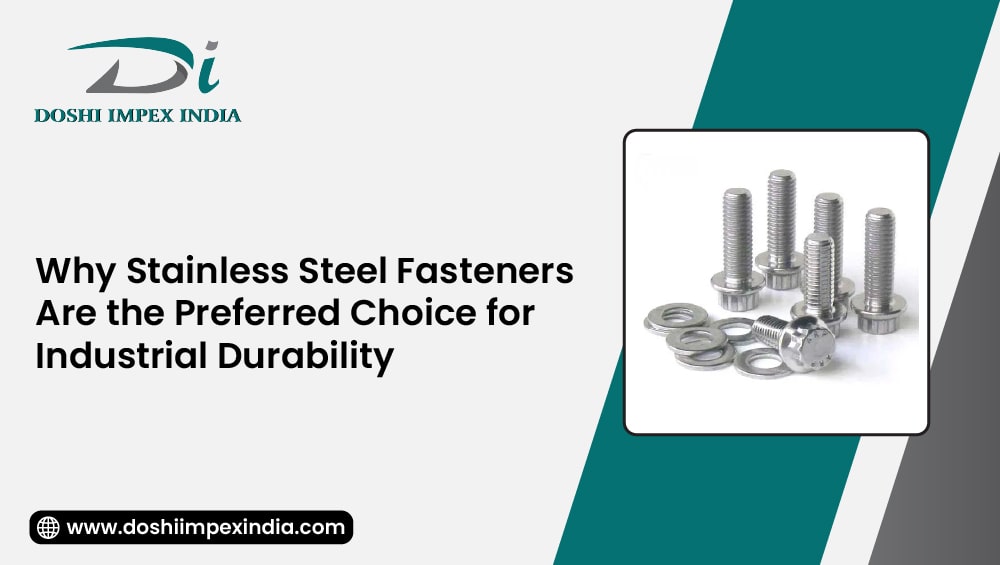
Why Stainless Steel Fasteners Are the Preferred Choice for Industrial Durability
Fasteners are used in many different sectors and for many different purposes. Selecting the incorrect industrial fasteners in India or abroad might have disastrous consequences, even though some people may not see any benefits or indicators immediately. Doshi Impex India is an SS fastener supplier and manufacturer, and this guide will examine common fastener designs and types, the best grades for particular conditions or applications, and factors that make stainless steel fasteners a preferred choice in industries.
What are stainless steel fasteners?
Stainless steel fasteners are components that connect or secure different kinds of pieces of industrial applications together. They are known for their fantastic ability to:
- Withstand rusting
- Avoid wear out,
- Degradation from the environment
- Ensure strong and solid connections in various mechanical and structural applications
- Great tensile strength
- Visually enticing
- Survive intense temperatures
- Works well in harsh environments
What are the different types of industrial fasteners in India made of stainless steel?
Common types of stainless steel fasteners include:
- Bolts
- Screws
- Nuts
- Washers
- Threaded rods.
Each particular type of fastener serves a distinct purpose. Stainless steel fasteners are appropriate for use in the following industries:
- Construction
- Maritime
- Aerospace
- Engineeering
- Food and Beverage
What are the advantages of SS fasteners?
SS fastener suppliers produce fasteners that have several advantages, which are mentioned below:
- It does not rust
- It is resistant to temperature fluctuations and heat.
- It can resist temperatures of up to 300°C and high levels of humidity.
- They are long-lasting.
- It has the property of being infinitely recyclable and maintains its quality over time.
- Stainless steel has an inert surface that prevents the fasteners from becoming contaminated, thereby protecting your operation in food processing, beverage making, and pharma units where hygiene is very important.
- These fasteners are easy to clean and maintain.
- The fasteners made out of SS are aesthetically pleasing and come in a variety of finishes.
International Standards for Stainless Steel
| Standard Body | Standard Code Examples | Scope |
| ASTM | ASTM A193, A194, A240, A276, A312 | Chemical composition, mechanical properties, dimensions for fasteners, plates, bars, pipes |
| ISO | ISO 3506, ISO 4954 | International material, testing, and performance specifications |
| EN | EN 10088, EN 10269 | SS grades, chemical compositions, and mechanical properties |
| JIS | JIS G4303, JIS G4304 | SS bars, plates, and pipes |
| DIN | DIN 1.4301, DIN 1.4462 | Numerical grade designations and technical requirements |
| ASME | ASME B18.2.1, ASME SA-193 | Standards for pressure vessels, bolting, and mechanical components |
Grades of Stainless Steel
| Category | Common Grades | Key Features |
| Austenitic | 304, 304L, 316, 316L, 321, 904L | Excellent corrosion resistance, non-magnetic, good formability |
| Ferritic | 409, 430, 446 | Good corrosion resistance, magnetic, and lower cost |
| Martensitic | 410, 420, 431 | High strength, wear resistance, moderate corrosion resistance |
| Duplex | S31803 (2205), S32205, S32750, S32760 | High strength, excellent corrosion resistance, good weldability |
| Precipitation Hardening (PH) | 17-4PH, 15-5PH | High strength, good corrosion resistance after heat treatment |
3. Certifications
| Certification Type | Description |
| ISO 9001 | Quality Management System certification |
| ISO 14001 | Environmental Management certification |
| ISO 45001 / OHSAS 18001 | Occupational Health & Safety |
| EN 10204 3.1 / 3.2 | Mill Test Certificates (MTC) for chemical & mechanical data |
| NACE MR0175 / ISO 15156 | Compliance for sour service (oil & gas) |
| PED (Pressure Equipment Directive) | EU compliance for pressure equipment |
| RoHS / REACH | Environmental & hazardous substance compliance |
Supreme Practices for Installation and Maintenance
- The perfect installation method is essential for fasteners. SS316, SS304 fasteners And other such fasteners require specific and correct equipment to ensure complete process application.
- And take the right approach to fulfill your project’s expectations and ensure that you do not exclude the chances of damage.
- Use the perfect torque to evade overtightening or loosening over time.
- Use lubricants to shun the possibilities of galling, which is a typical problem with stainless steel fasteners.
- Manufacturers of stainless steel bolts and other fasteners should ensure material compatibility to eliminate the probability of galvanic corrosion. This will guarantee that fasteners and the resources they link to are efficient.
- Engineers should inspect fasteners like SS304, SS316 regularly because it resolves the following issues in time and avoids further damage:
- Wear
- Loosening
- Corrosion.
- Technicians should clean fasteners regularly to remove the following that can decreases performance quality:
- Dirt
- Grease
- Pollutants
- Sometimes, the environmental or industrial condition can be severely corrosive. In such situations, corrosion-resistant grades such as SS 316 fasteners prove to be long-lasting.
Material comparisons of various fasteners
1. SS vs Carbon Steel
| Feature | Stainless Steel | Carbon Steel |
| Corrosion Resistance | Excellent due to the chromium oxide layer | Poor, requires coating or painting |
| Strength | High tensile strength, especially in Duplex grades | High strength, but can be brittle without alloying |
| Maintenance | Low (no painting needed) | High (needs protection against rust) |
| Cost | Higher | Lower |
| Best For | Marine, food processing, chemical plants | Structural steel frames, automotive chassis |
2. Stainless Steel vs Aluminum
| Feature | Stainless Steel | Aluminum |
| Corrosion Resistance | Excellent | Very good, forms a natural oxide layer |
| Weight | Heavy (density ~8 g/cm³) | Lightweight (density ~2.7 g/cm³) |
| Strength | Higher tensile strength | Lower, but good strength-to-weight ratio |
| Thermal Conductivity | Lower | High (good for heat sinks) |
| Cost | Higher | Lower to moderate |
| Best For | High-strength, high-corrosion applications | Aerospace, automotive, lightweight structures |
3. SS vs Brass
| Feature | Stainless Steel | Brass |
| Corrosion Resistance | Excellent | Good, but it can tarnish |
| Strength | Higher | Lower |
| Machinability | Harder to machine | Easy to machine |
| Appearance | Silver, modern look | Gold-like, decorative look |
| Best For | Structural, marine, food-grade uses | Decorative hardware, plumbing fittings |
4. Stainless Steel vs Copper
| Feature | Stainless Steel | Copper |
| Corrosion Resistance | Excellent | Good, but it can develop green patina |
| Strength | High | Low |
| Thermal & Electrical Conductivity | Low | Very high |
| Cost | Lower than copper (in most grades) | High |
| Best For | Strength and corrosion resistance | Electrical wiring, heat exchangers |
Conclusion
Stainless steel fasteners are preferred because of their
- Exceptional strength
- Durability
- Corrosion resistance.
It is an excellent choice for the following:
- Heavy-duty and powerful machinery
- Industrial plants
- Equipment
They are the best industrial fasteners in India because of their:
- Affordability
- Adaptability
- Low maintenance needs.
Stainless steel is a great material for situations where design and aesthetics are crucial since it can be machined and polished in a variety of ways. They are dependable with unmatched benefits, regardless of your industry, both industrial and aerospace.
Doshi Impex India is a stainless steel bolt and other fastener manufacturer with a skilled team of experts. We specialize in quality-tested SS304, SS316, and various other grades of fasteners. We are an SS fasteners supplier that can provide you with not just products but also complete guidance through our custom solutions.
Get in touch with us now to get the best fastener solution for your project on +91 9833907060 and +91 9653630128 or email us at [email protected] or [email protected].