


 Call +91 9833907060
 Send E-mail
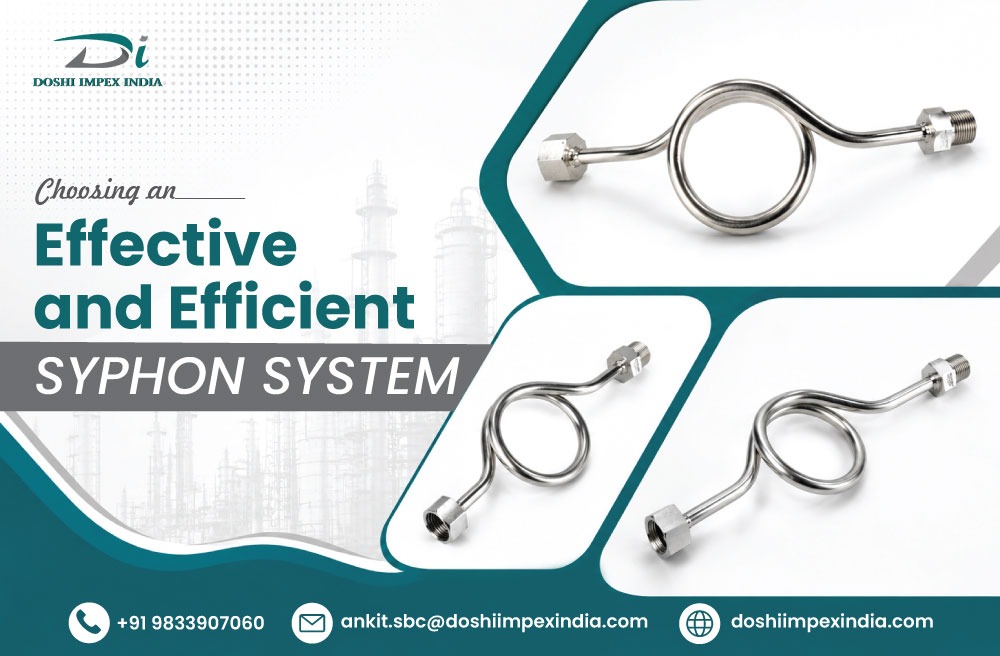
A well-designed syphon system is a simple yet highly effective solution for transferring or draining liquids by using gravity, pressure difference, and elevation rather than relying entirely on mechanical pumping. From industrial piping and drainage applications to water management and pressure-instrument protection, syphon or siphon systems can improve operational efficiency when correctly selected and installed.
For businesses looking for reliable piping and industrial components, Doshi Impex India provides a wide range of pipes, tubes, and pipe fittings suitable for different industrial requirements. Its product range includes stainless steel, carbon steel, and other specialized piping products.
What Are Syphon Pipes?
Syphon pipes, also written as siphon pipes, are pipes or tubes arranged to allow a liquid to move from a higher level to a lower level, often passing over an intermediate high point. The term siphon generally refers to a tube or piping arrangement that enables liquid transfer through a combination of gravity and pressure differences.
A basic siphon has an inlet positioned in the higher liquid reservoir, a raised section or crest, and an outlet at a lower elevation. Once the pipe is properly filled or primed and the outlet is lower than the source liquid level, the liquid can continue flowing.
The scientific principle behind a siphon involves pressure, elevation, and gravity. As liquid moves downward on the outlet side, its potential energy is converted into kinetic energy, while friction and other losses influence the actual flow rate.
How a Siphon Works
Understanding how a siphon works starts with the difference between the source and discharge levels.
The basic process is:
- The siphon pipe is filled with liquid or otherwise primed.
- The inlet remains submerged in the higher-level liquid.
- The pipe rises above the source liquid level.
- The outlet is positioned at a lower elevation.
- Gravity acting on the liquid column in the descending section creates the pressure difference that sustains flow.
- Liquid continues moving until the elevation difference or operating conditions no longer support the siphoning action.
The pipe must remain sufficiently filled and sealed. Air entering the elevated section can interrupt the continuous liquid column and cause the siphon to lose its effectiveness.
Importantly, a siphon does not create energy. Its operation depends on the available hydraulic head and is affected by pipe diameter, pipe length, elevation difference, bends, fittings, and friction losses.
Types of Siphon Systems
There are several Types of siphon systems, and the correct choice depends on the application.
1. Simple Siphon System
This is the basic inverted-U arrangement used for transferring liquids between different elevations. It is suitable for relatively simple water-transfer and drainage applications.
2. U-Type Siphon
The U-type design is commonly used in piping and instrumentation applications. Its geometry can provide a liquid seal and, depending on the application, help isolate instruments from process conditions.
3. Coil or Loop Siphon
Coil-type siphons are used where a compact configuration and additional condensation or heat-transfer path are desirable. Industrial pressure-gauge siphons are commonly manufactured in materials such as stainless steel and carbon steel.
4. Pigtail Siphon
A pigtail siphon is a looped configuration frequently used with steam pressure gauges. Condensate inside the loop forms a barrier between high-temperature steam and the pressure instrument, helping reduce direct heat exposure.
5. Automatic Pond Siphon System
An automatic pond siphon system is designed to drain or regulate water automatically once a predetermined water level or hydraulic condition is reached. Bell-siphon arrangements are commonly associated with automatic drainage in ponds, aquaponics, and water-management systems.
For an automatic system, careful attention must be given to pipe diameter, inlet configuration, discharge elevation, priming, and the mechanism used to initiate and terminate siphoning.
How Siphon Pipes Function
The functioning of siphon pipes depends primarily on the elevation difference between the liquid source and discharge point. Once a continuous liquid column is established, the descending side of the pipe pulls liquid through the system because of the difference in hydraulic head.
In practical industrial applications, however, siphon performance is not determined by elevation alone. Pipe friction, internal diameter, fittings, bends, valves, and the physical characteristics of the liquid can significantly affect flow.
For pressure-gauge applications, the purpose is somewhat different. A syphon is installed between the process connection and pressure gauge, where condensed liquid in the syphon can provide a protective barrier against high-temperature steam. Industrial syphons are available in materials including SS316, carbon steel, and other alloys, with specifications selected according to pressure and temperature requirements.
Benefits of Siphon Pipes
A properly designed siphon system can provide several advantages:
- No continuous pumping requirement: Gravity can provide the driving force in suitable applications.
- Energy efficiency: A passive siphon arrangement can reduce dependence on electrical pumping.
- Simple construction: Basic systems have relatively few moving parts.
- Low maintenance: Fewer mechanical components can mean fewer potential failure points.
- Reliable liquid transfer: Once correctly established, a siphon can provide continuous flow.
- Compact installation: Certain coil, U-type and pigtail configurations require comparatively little space.
- Protection of pressure instruments: Industrial syphons can reduce exposure of gauges to high-temperature steam.
- Material flexibility: Syphons can be manufactured from stainless steel, carbon steel, brass and specialized alloys depending on the application.
Syphon System Price in India
The syphon system price in India varies significantly according to the type, material, size, pressure rating, temperature rating, connection type, manufacturing standard, and quantity ordered.
As a broad market reference, current Indian listings show industrial stainless-steel siphon pipes around ₹900–₹1,062 per piece, while some published market guides indicate approximately ₹500–₹5,000 for medium brass/stainless-steel syphons and higher ranges for larger stainless-steel configurations. These figures are indicative rather than a fixed Doshi Impex India price.
For industrial procurement, buyers should request a quotation based on exact specifications instead of selecting solely on price. Doshi Impex India recommends providing details such as item, type, size, thickness/class/pressure, material, quantity, and end use to enable faster and more accurate quotations.
Why Choose Doshi Impex India?
Selecting the right supplier is important when sourcing industrial piping products. Doshi Impex India offers a broad range of pipes, tubes and fittings in different sizes, materials and specifications for industrial requirements.
For customers evaluating a syphon system, the right product should be selected according to operating pressure, temperature, fluid compatibility, connection requirements, and installation conditions.
Whether your requirement involves an industrial siphon pipe, instrumentation application, or specialized piping component, discussing the technical specifications with an experienced supplier can help ensure the selected product is suitable for its intended service.
An effective and efficient syphon system combines simple fluid mechanics with practical engineering to provide reliable liquid transfer, drainage, or instrument protection. From basic siphon pipes to U-type, coil, and pigtail designs, selecting the right configuration is essential for safe and dependable performance.
For industrial applications, Doshi Impex India can help customers evaluate piping requirements based on material, size, pressure, quantity, and end use. Proper product selection and installation can make a significant difference in the efficiency, durability, and reliability of any syphon-based system.
1. What is a syphon or siphon?
A syphon or siphon is a pipe or tube arrangement that transfers liquid from a higher elevation to a lower elevation using gravity and pressure differences. The pipe generally rises above the source liquid level before descending toward the outlet.
2. What is the siphon meaning in engineering?
In engineering, a siphon refers to a liquid-transfer arrangement in which a continuous liquid column and elevation difference enable flow through a pipe from a higher liquid level toward a lower discharge level.
3. What are the main Types of siphon systems?
Common Types of Syphon System include simple siphons, U-type siphons, coil-type siphons, pigtail siphons, and automatic or bell-siphon systems. The appropriate design depends on the application.
4. What is an automatic pond siphon system?
An automatic pond siphon system is a passive water-drainage arrangement designed to start and stop drainage based on water level and hydraulic conditions, reducing the need for manual intervention or continuous pumping.
5. How much does a syphon system cost in India?
The syphon system price in India depends on material, dimensions, pressure rating, connections, and application. Indicative industrial market listings range from hundreds to several thousand rupees per piece, while customized or higher-rated systems may cost more. A project-specific quotation should be obtained from the supplier.