


 Call +91 9833907060
 Send E-mail
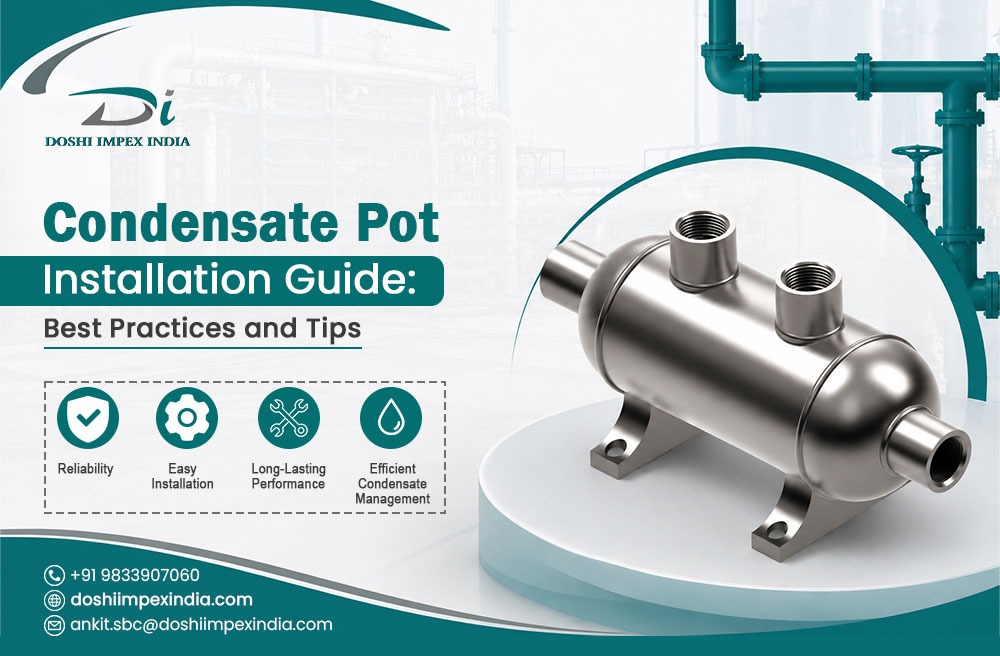
Precise measurement of pressure and differential pressure is crucial in steam and high-pressure process systems for safe and efficient plant operation. The role of a Steam condensate pot is very important in maintaining a stable liquid column between the process and instrumentation. But no matter how well made a condensate pot is, it can perform poorly when it’s not set up properly.
This Steam condensate pot installation guide explains the concept of a condensate pot, the importance of proper installation, the tools required, installation best practices, considerations for selection, and recommended tips from Doshi Impex India.
What is a Condensate Pot?
A condensate pot is a pressure-retaining container that is employed to receive and hold condensate in an impulse line in a measurement system that measures steam or vapour. It serves as a barrier between the high-temperature steam and a sensitive measuring instrument like a pressure gauge, pressure transmitter, and differential-pressure transmitter.
When steam is used for measurement, condensation is a natural by-product of the cooling of the steam in the impulse tubing. A condensate pot ensures a controlled liquid reservoir and creates greater stability for measurements, due to the controlled hydrostatic head. For differential pressure applications, one pot is normally placed on each of the impulse lines, with the high- and low-pressure side of the pot arranged to keep the pressure heads on both sides as equal as possible.
Why is it significant to have Proper Condensate Pot Installation?
Steam condensate pot installation is critical for the accuracy of the measurement, protection of the equipment, and operational reliability. Errors can occur due to incorrect elevation, tubing setup, trapped air, inadequate tubing drainage, or unequal impulse-line setup.
Normally, both the condensate pots should be at the same elevation to maintain the balance of the heads of the liquid in them for measuring the DP. The impulse lines must also be laid out carefully, and should be as short as possible on the vapour side.
This can be aided by proper installation:
- Take accurate pressure and DP readings
- Keep tools away from hot steam directly coming from them.
- Reduce pressure-head errors
- Help with maintenance and calibration
- Avoid build-up of dirt and trapped gases
- Improve the overall reliability of instrumentation
The tools and equipment that are needed:
We at Doshi Impex India recommend that you take the necessary steps before installing. Typical requirements include:
Placed in a condensate pot that is appropriate for the application.Lands in a condensate pot appropriate to the application.
- Isolation valves
- Drain/vent or bleed valves.
- Stainless steel or appropriate alloy tubing.
- Tube fittings, connectors
- Mounting brackets/supports
- Pressure Gauge or DP Transmitter
- Pipe/tube wrenches
- Appropriate sealing materials
- Heat tracing or insulation (when necessary)
Specific equipment is dependent on the process pressure, temperature, fluid, piping, and instrumentation specification.
Installation of Condensate Pot followed by Doshi Impex India:
When choosing the position and connection of the condensate pots, it is important to take into account the following factors, according to us at Doshi Impex India. They are:
.1. Set the correct coordinates for the index. Set the correct location of the index.
Position the condensate pot as close to the process connection as possible, ensuring easy access for inspection and maintenance. In a differential-pressure system, the high- and low-pressure condensate pots must be at the same elevation.
- Maintain Correct Orientation:
The orientation should be done according to the manufacturer’s design and the approved piping/instrumentation drawing. A typical installation includes proper inlet, outlet, drain, and vent connections for collecting, draining, and venting condensate.
- Configure impulse lines properly
Impulse lines should be designed to minimize unnecessary bends, pockets and restrictions. For DP applications, it is important to keep the two sides as symmetrical as possible for the sake of minimising hydrostatic head differences.
- Control the roots and vegetation along the soil boundaries.6. Allow for Isolation and Drainage.
Isolation valves allow the instrumentation to be safely isolated during calibration or maintenance. A drain/blowdown facility will assist in eliminating any debris and unwanted material that may have been accumulated in the impulse lines. Parker’s installation guidelines also advocate blowdowns on impulse lines as appropriate.
- Think about Insulation and Heat Tracing
The condition of the condensate in impulse lines may be influenced by temperature variations in the environment. Depending on the application, insulation or heat tracing may be required. The need should not be considered at the end of the system design.
Choosing the appropriate Condensate Pot as per Doshi Impex India recommendations
The first step toward selecting the right condensate pot is to find out about the operating conditions. Consider:
- Operating pressure
- The temperature at which the instrument operates and is designed for.
- The properties of the steam or process fluid.The characteristics of the steam or process fluid.
- Material compatibility
- Required volume
- Number and type of connections
- The need for draining and venting
- Mounting arrangement
- Specifications/certifications applicable
According to the published information available at Doshi Impex India, it supplies these products in materials such as SS 304, SS 316, carbon steel, alloy steel, Monel, Inconel, and Hastelloy, and can be customized in size and connection configuration depending on the application requirements.
Thus, buyers should not just look at the price of a condensate pot, but should compare it with more than just the upfront price. The final cost may be affected by the grade of material, pressure rating, dimensions, connection configuration, testing, and customization and quality assurance.
Why Choose Condensate Pot from Doshi Impex India?
Doshi Impex India specializes in engineered solutions in the domain of industrial applications. The company publishes information about condensing products and provides precision-manufactured products, corrosion-resistant material options, and customized port arrangements and pressure-integrity testing.
This makes us an ideal choice for customers who require application-specific condensate pots, rather than generic components.
Doshi Impex India Tips for a Correct Condensate Pot Installation:
For a reliable installation, our experts at Doshi Impex India recommend paying particular attention to:
- Check the design of the condensate pot before installation.
- Check the pressure and temperature ratings.
- Verify required connections, numbers, and position.
- Properly balance HP and LP configurations for DP applications.
- Do not have unneeded impulse-line length.
- Produce appropriate isolation, drain, and vent arrangements.
- Check all tubing and fittings for leakage.
- Make sure that the condensate pot is well supported.
- Implement acceptable plant drawings and engineering standards.
- Test the full system before commissioning.
- When installing a condensate pot, you can also use these additional tips from Doshi Impex India.
Before commissioning, examine the entire assembly for mechanical damage, improper connections, and leaks. Check to ensure that the condensate pots are set at the designated height and that the impulse lines are not blocked.
If blowdown facilities are available, make a proper blowdown procedure to clear accumulated debris. If the ambient temperature is low, consider insulation or heat tracing and/or an appropriate freeze protection plan. Parker also suggests looking into the insulation/heat tracing and, if applicable, the use of antifreeze media for impulse water-filled systems.
The following represent some potential uses for Condensate Pot:
Industries where steam and vapour measurement applications are common are:
- Power generation
- Oil and gas
- Petrochemical plants
- Chemical processing
- Refineries
- Process industries
- Boilers and steam systems
- Industrial instrumentation
- Heat-transfer and utility systems
Their primary role is to support reliable pressure or differential-pressure measurement where steam or vapour condensation can affect instrumentation.
A condensate pot is a relatively compact component, but its installation can have a significant impact on instrumentation accuracy and system reliability. Correct elevation, suitable materials, balanced impulse lines, proper isolation, drainage, and regular inspection are all important parts of successful steam condensate pot installation.
For application-specific requirements, selecting the right product is equally important. Doshi Impex India provides condensate-pot solutions with different materials, sizes, and connection options to suit industrial requirements. Before purchasing, evaluate operating conditions and technical specifications rather than focusing only on Condensate Pot Price in India.
For dependable industrial instrumentation components, Doshi Impex India can help customers identify a condensate pot configuration suited to their application.
1. What is the purpose of a condensate pot?
A condensate pot collects and maintains condensate in steam impulse lines, helping create a stable liquid head and protect pressure or DP instruments from direct exposure to high-temperature steam.
2. Where should a steam condensate pot be installed?
The installation location depends on the measurement arrangement. In DP applications, the HP and LP condensate pots should generally be positioned at the same elevation, with impulse lines arranged as symmetrically as practical.
3. What materials are available for condensate pots?
Depending on the application, condensate pots can be manufactured from materials such as stainless steel, carbon steel, and specialized alloys including Monel, Inconel, and Hastelloy. Material selection should be based on pressure, temperature, and fluid compatibility.
4. What factors affect Condensate Pot Price in India?
Price can vary according to material grade, size, pressure rating, number of ports, connection type, customization, testing requirements, and quantity.
5. How can I choose the right condensate pot?
Consider operating pressure and temperature, fluid compatibility, required volume, connection configuration, installation orientation, and instrumentation requirements. Consulting the manufacturer before ordering can help ensure the selected condensate pot matches the application.