


 Call +91 9833907060
 Send E-mail
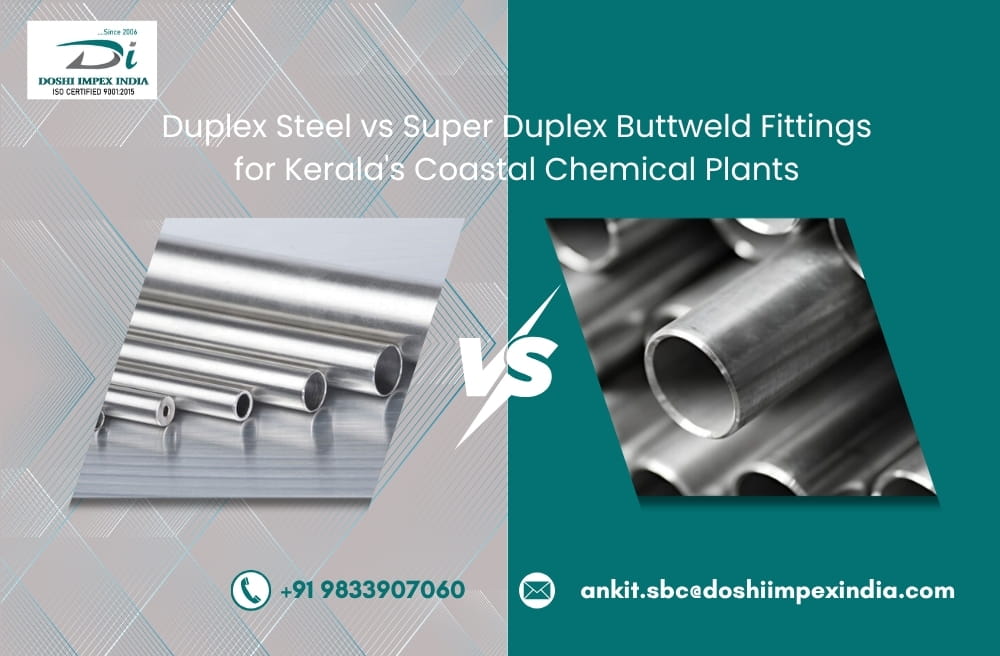
The coastal belt of Kerala is home to several chemical processing plants, fertilizer plants, petrochemical plants, and industries located in the sea. Such environments subject the piping systems to high humidity, seawater with chlorides, and harsh chemical liquids, and the choice of material is essential to durability. Among the key decisions that engineers take is whether to use duplex steel buttweld fittings or super duplex buttweld fittings.
The two materials are extensively employed in pipelines, heat exchangers, and chemical processing systems because it is of excellent strength and resistant to corrosion. Their performance, however, varies widely in highly corrosive environments along the coast. The blog will compare duplex steel and super duplex buttweld fittings and discuss the most appropriate one to use in the coastal chemical plants in Kerala.
What Are Buttweld Fittings of Duplex Steel?
Duplex stainless steel buttweld fittings are piping fittings that are composed of a dual-phase microstructure made of ferrite and austenite. This balanced arrangement of duplex steel provides the material with a strength and corrosion resistance greater than that of traditional stainless steel, such as 304 or 316.
The average chemical makeup is that of chromium, nickel, molybdenum, and nitrogen. These alloying elements contribute to the resistance of the material to corrosion, stress corrosion cracking, and chloride attack.
Important Characteristics of Duplex Buttweld Fittings.
- High mechanical strength
- Good resistance against stress corrosion cracking.
- Good fabrication and weldability.
- Intermediate resistance to pitting and crevice corrosion.
Duplex steel fittings are commonly used in:
- Chemical processing plants
- Petrochemical pipelines
- Wastewater treatment systems
- Marine equipment
Owing to their ability to balance the cost and performance, duplex fittings have found extensive application in moderately corrosive environments.
What Are Buttweld Fittings, Super Duplex?
Super duplex stainless steel- It is the improved version of duplex steel containing more chromium, molybdenum and nitrogen. These other alloying elements are quite effective in enhancing corrosion resistance and mechanical strength.
The Pitting Resistance Equivalent Number (PREN) of super duplex alloys is normally higher than 40 in contrast to 30 to 35 of standard duplex steels. Such an enhanced PREN value implies better resistance to localized corrosion like pitting and crevice corrosion.
Significant Characteristics of Super Duplex Buttweld Fittings.
- Better seawater corrosion resistance.
- Increased tensile and yield strength.
- Very good pitting and crevice corrosion resistance.
- Excellent performance in hostile conditions.
These fittings are popular in:
- Platforms in offshore oil and gas.
- Desalination plants
- Marine engineering systems
- Chemical processing units that are highly corrosive.
In marine chemical plants that are in contact with seawater and harsh chemicals, the super duplex materials are invaluably reliable.
The major differences between Duplex and Super Duplex Buttweld Fittings.
The simplified comparison of the two materials is given below:
| Feature | Duplex Steel Buttweld Fittings | Super Duplex Buttweld Fittings |
| Chromium Content | ~22% | ~25% |
| PREN Value | 30–35 | 40+ |
| Corrosion Resistance | Good | Excellent |
| Strength | High | Very High |
| Cost | Lower | Higher |
| Ideal Environment | Moderate corrosion | Severe corrosion |
Super duplex fittings have an increased level of chromium and molybdenum, which increases the resistance to pitting corrosion and stress corrosion cracking in the chloride-bearing environment like seawater.
The reason why Coastal Chemical Plants in Kerala should be equipped with advanced materials.
The chemical plants on the coast of Kerala have several operational issues:
- Chloride-Rich Marine Environment
Seawater has high levels of chlorides, which increase the rate of corrosion on normal stainless steels.
- Humidity and Temperature
The corrosion rate is accelerated by the tropical climate in pipelines and fittings.
- Chemical Exposure
Piping materials may be degraded by acid, alkali, and process chemicals.
Due to such reasons, the industries have to use high-performance corrosion-resistant alloys in piping systems.
Duplex Buttweld Fittings: When is it the Right Choice?
Duplex fittings are still a good option in most chemical processing systems. They can be used when:
- There is moderate exposure to chemicals.
- Limited contact with seawater.
- Budget constraints are important
- Strength is required, but extreme corrosion resistance is not necessary
Duplex steel fittings are used in many fertilizer plants, water treatment systems, and networks of piping in storage tanks since they perform economically.
In cases where Super Duplex Buttweld Fittings are superior.
Super duplex fittings are suggested to be used in very marine and chemical environments, particularly the coastal areas.
They are best when:
- Aggressive chemicals are carried by pipelines.
- Direct seawater operation is used on the equipment.
- An extended service life is needed.
- There should be an elimination of maintenance downtime.
As an example, a super duplex alloy is usually employed in offshore and desalination facilities since it resists pitting corrosion even in areas with very salty water.
They cost more, but have greater longevity, which can save on maintenance expenses.
Applications in Kerala’s Coastal Chemical Industry
Buttweld fittings (duplex and super duplex) are commonly used in:
Chemical Processing Plants
- To carry the corrosive chemicals and acids.
- Marine Chemical Facilities
- Applied in seawater cooling systems and pipelines.
Fertilizer Manufacturing Units
- Working with violent chemical substances.
- Desalination and Water Treatment Plants.
- In places where piping systems are in constant contact with the saltwater.
In very corrosive conditions, such as the coastlines of Kerala, super duplex fittings can be a more reliable way of operation.
Why Choose Doshi Impex India?
Doshi Impex India is a trusted supplier of high-quality duplex and super duplex buttweld fittings designed for demanding industrial environments.
Key Advantages
- Premium corrosion-resistant alloys
- Precision manufacturing and strict quality control
- Compliance with international standards
- Reliable supply for chemical and petrochemical industries
With years of experience in the stainless steel piping industry, Doshi Impex India delivers durable solutions for coastal chemical plants across India.
Both duplex and super duplex buttweld fittings offer excellent performance in industrial piping systems. Duplex steel fittings provide a cost-effective solution for moderate corrosion environments, while super duplex fittings deliver superior resistance and strength in highly aggressive coastal conditions.
For chemical plants located along Kerala’s coastline, where pipelines face constant exposure to seawater and harsh chemicals, super duplex buttweld fittings are often the more reliable long-term choice. Selecting the right material ensures improved safety, reduced maintenance, and longer service life for critical piping systems.
-
What is the difference between duplex and super duplex butt-weld fittings?
Duplex buttweld fittings contain a balanced ferrite-austenite structure with good corrosion resistance, while super duplex fittings have higher chromium, molybdenum, and nitrogen content for superior strength and corrosion resistance.
2. Why are super duplex fittings used in coastal chemical plants?
Super duplex fittings resist chloride corrosion, pitting, and stress corrosion cracking, making them ideal for marine environments and chemical processing systems.
3. Are duplex steel fittings suitable for chemical industries?
Yes, duplex steel fittings are widely used in chemical and petrochemical industries because they provide high strength and good corrosion resistance at a lower cost.
4. Which is better for seawater applications: duplex or super duplex?
Super duplex is generally better for seawater applications because it has higher PREN values and stronger resistance to pitting and crevice corrosion.
5. Where can I buy duplex and super duplex buttweld fittings in India?
You can purchase high-quality duplex and super duplex buttweld fittings from reliable suppliers like Doshi Impex India, which offers corrosion-resistant piping solutions for the chemical and marine industries