


 Call +91 9833907060
 Send E-mail
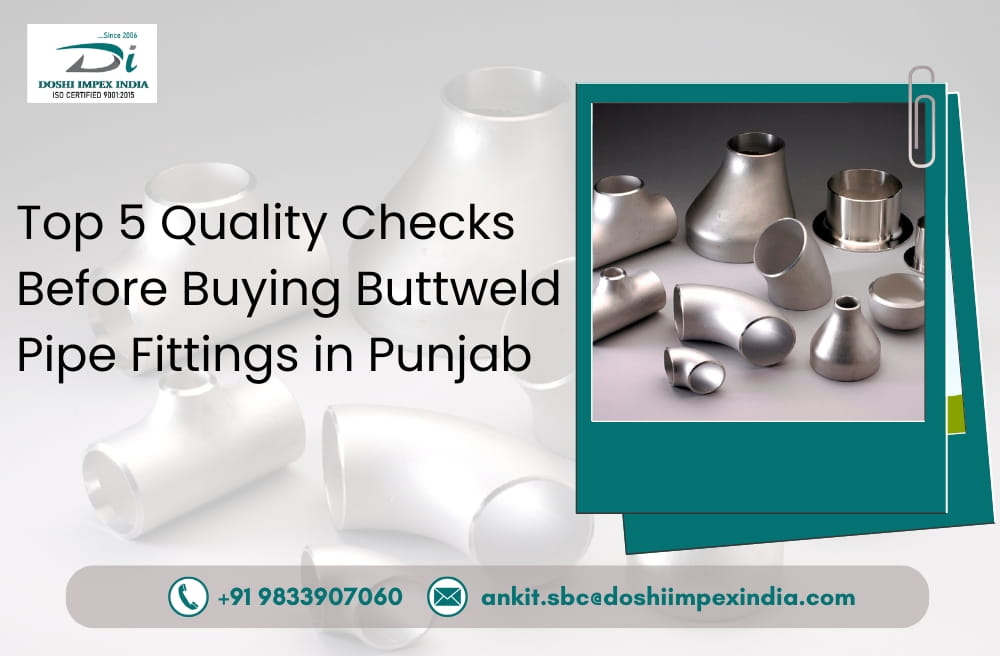
Industrial piping systems are very dependent on high quality fittings to ensure safety, durability and efficiency. Of these parts, butt-weld pipe fittings find extensive application in oil and gas industries, chemical processing industries, water treatment industries, power plants, and manufacturing plants.
These fittings are permanently welded into the piping system, hence replacing faulty fittings may be costly and time consuming. So, it is necessary to conduct effective quality checks prior to acquiring them. The dimensions, tolerances, and testing needs of factory-made buttweld fittings in industrial pipelines are specified by American Society of Mechanical Engineers standards such as ASME B16.9.
To buyers in Punjab who want to have a good industrial piping solution, engaging trusted suppliers like Doshi Impex India and ensuring the quality of products before buying ensures that operation breakdowns and expensive downtime are avoided. This is a guide on the best 5 quality checks to consider before purchasing butt-weld pipe fittings in Punjab.
- Review of adherence to Global Standards.
The initial and primary quality assurance is to ensure that the buttweld pipe fittings are in line with the accepted international standards. These standards guarantee compatibility, safety, and performance in industrial piping systems.
The most popular standards are:
- ASME B16.9 – Factory-welded fittings, wrought.
- ASTM A234 – Material specification of carbon and alloy steel fittings.
- MSS SP-43 – Stainless steel buttweld fittings.
- EN 10253 – European standards for pipe fittings
The standards establish important parameters like dimensional tolerances, wall thickness, and mechanical testing requirements.
Unless the fittings are of these standards, they may not fit or be able to endure the pressure of the operation. Always demand standard compliance records or certificates before buying butt-weld fittings in Punjab.
- Check the Grade of Material and Composition of Chemicals.
The quality of materials is important in the strength, corrosion resistance, and durability of buttweld pipe fittings. Various industries need various grades of materials based on temperature, pressure, and fluid type.
Welded fittings made using buttweld include:
- Carbon Steel (ASTM A234 WPB)
- Stainless Steel (304, 304L, 316, 316L)
- Alloy Steel (WP5, WP11, WP22)
- Stainless Steel Duplex and Super Duplex.
Testing of materials is done to verify that the fitting has the right chemical composition, tensile strength, and yield strength to be used in industries.
Mill Test Certificates (MTC) or EN 10204 3.1 certificates to verify the grade and composition of the material should be supplied by a reputable supplier, such as Doshi Impex India.
- Check Dimensional Accuracy and Tolerances.
The dimensions should be accurate to allow welding and installation without leaks. When the fitting sizes are not in line with pipeline requirements, this may cause alignment or poor weld joints.
Quality inspection should include:
- Outside diameter measurement
- Wall thickness verification
- Center-to-end dimensions
- Bevel angle and end preparation of a weld.
The fact that standards like ASME B16.9 specify very tight dimensional tolerances to guarantee consistency among manufacturers.
The fittings used in our project before buying the buttweld pipe fittings in Punjab, make sure the fittings are of the correct size, schedule, and design for the project.
- Perform Visual and Surface Inspection
Vision inspection is a simple yet essential procedure in the detection of errors in manufacturing. The poor surface quality could be a sign of production problems, even though a fitting fits the technical specifications.
Inspection: Check during inspection:
Cracks or scratches on the surface.
- Porosity or pits
- Welding defects
- Uneven surface finish
- Distortion or deformation
Good-quality fittings must possess smooth surfaces, even thickness, and beveled correctly to provide good welding and long life.
Before fittings are sent out, the professional suppliers normally carry out 100% of the visual inspection and surface inspection.
- Authenticate Non-Destructive Testing (NDT) and Quality Reports.
For critical industrial applications, advanced testing methods are used to detect internal defects that cannot be seen with the naked eye.
Popular testing techniques are:
- Ultrasonic Testing (UT) – Internal defects.
- Radiographic Testing (RT) – Determines internal cracks or voids.
- Dye Penetrant Testing (PT) – Reveals surface defects
- Positive Material Identification (PMI) – check material composition.
These non-destructive tests are used to ensure that the fittings are free from internal defects and that they can be used in high-pressure or high-temperature environments.
Before purchasing butt-weld pipe fittings in Punjab, demand an inspection report, NDT test certificate, and third-party quality approval to ensure the reliability of the products.
The importance of selecting a Reliable Supplier.
Though quality checks are important, choosing the appropriate supplier is also crucial. As manufacturers and suppliers, they are reliable and ensure that the quality is fully controlled in the entire production process, starting with the procurement of raw materials to the end inspection of the product.
When choosing a buttweld fittings supplier in Punjab, consider:
- Experience and reputation in the industry.
- ISO certifications
- Quality testing facilities
- Adherence to international standards.
- The capability of giving full documentation.
Other companies, such as Doshi Impex India, specialize in the provision of certified butt-weld pipe fittings to meet international quality standards in long-lasting performance and safety of industrial pipelines.
Industrial piping systems heavily depend on buying buttweld pipe fittings. Substandard fittings may cause leakages, malfunctions, and expensive downtime. Thus, it is crucial to do adequate quality checks prior to buying.
In conclusion, the five best quality inspections before purchasing butt-weld pipe fittings in Punjab are:
- Check against international standards such as ASME B16.9.
- Authenticate the grade and chemical composition of the material.
- Check dimensional accuracy and tolerances
- Conduct physical and surface examination.
- Provide non-destructive test and certification.
With these checks in mind and sourcing of products through reputable suppliers such as Doshi Impex India, the businesses will be able to have safe, efficient, and long-lasting piping systems.
1. What are buttweld pipe fittings used for?
Buttweld pipe fittings are used to connect pipes, change flow direction, or reduce pipe size in industrial piping systems. They are commonly used in oil & gas, chemical plants, power plants, and water treatment facilities.
2. Which standard is used for buttweld pipe fittings?
The most common standard is ASME B16.9, which defines the dimensions, tolerances, and manufacturing requirements for factory-made buttweld fittings.
3. How can I check the quality of butt-weld pipe fittings?
You can check quality by verifying material certificates, inspecting surface finish, measuring dimensions, and reviewing non-destructive testing reports such as UT, RT, and PMI tests.
4. Which materials are commonly used in buttweld fittings?
Common materials include carbon steel (ASTM A234 WPB), stainless steel (304, 316), alloy steel, duplex stainless steel, and nickel alloys.
5. Where can I buy high-quality buttweld pipe fittings in Punjab?
You can purchase certified butt-weld pipe fittings from trusted suppliers like Doshi Impex India, who provide fittings that comply with international standards and quality testing requirements.