


 Call +91 9833907060
 Send E-mail

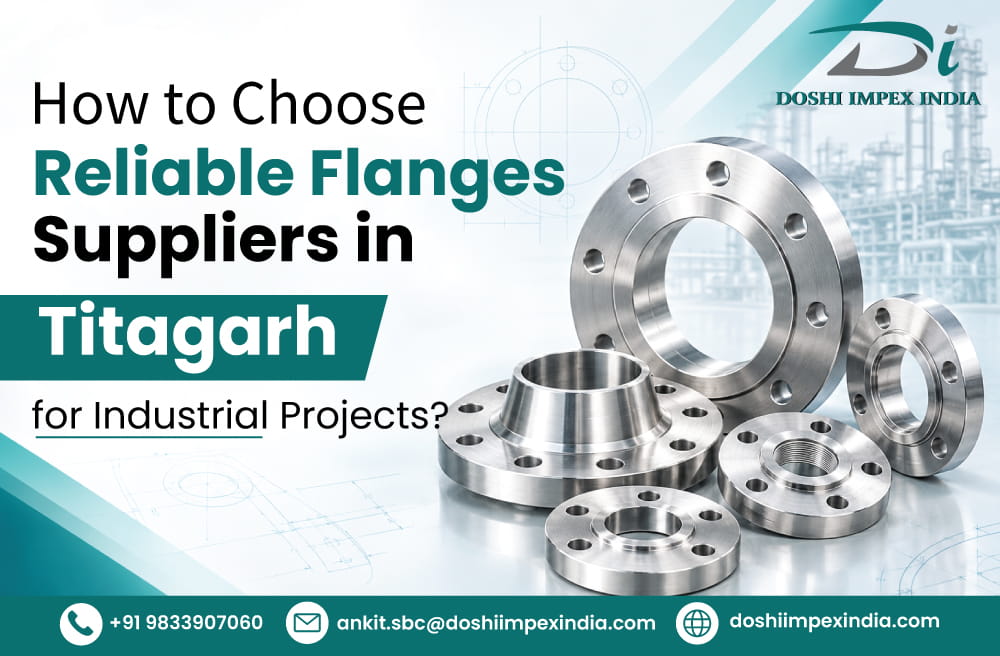
In industrial projects, every component has a role to play in maintaining operational efficiency, safety, and long-term reliability. Flanges are among the essential components used to connect pipes, valves, pumps, and other equipment in industrial piping systems. Although they may appear to be relatively simple mechanical components, selecting the wrong flange can lead to leakage, maintenance issues, installation delays, and unnecessary project costs.
For procurement managers, project engineers, contractors, and industrial buyers, choosing reliable flange suppliers in Titagarh is therefore an important decision. Titagarh, located in the North 24 Parganas district of West Bengal, is part of the wider industrial belt surrounding Kolkata. Businesses sourcing industrial piping components in this region need suppliers who understand technical specifications, material requirements, documentation, and delivery schedules.
At Doshi Impex India, the approach to industrial procurement begins with understanding project requirements rather than simply comparing quotations. A reliable supplier should help buyers identify suitable flange specifications, verify product quality, and make informed purchasing decisions that support the entire project lifecycle.
Evaluate the Supplier’s Product Knowledge and Experience
The first step in identifying dependable flange suppliers in Titagarh is to evaluate their understanding of industrial piping requirements. Different projects operate under different pressure conditions, temperatures, and environmental challenges. Consequently, the same flange type may not be suitable for every application.
A competent supplier should understand common flange categories, including:
- Weld neck flanges for demanding piping applications.
- Slip-on flanges for suitable general industrial connections.
- Blind flanges for closing pipe ends or isolating sections.
- Socket weld flanges for certain small-bore piping systems.
- Threaded flanges for compatible threaded connections.
- Lap joint flanges for applications requiring alignment flexibility.
Buyers should also ask whether the supplier can source flanges in the required materials, dimensions, pressure classes, and applicable standards.
For example, a chemical processing facility may require corrosion-resistant materials, while a conventional industrial utility line may have different material and pressure requirements. The supplier’s ability to understand these differences can help prevent costly procurement errors.
Verify Material Grades and Applicable Standards
Material quality is one of the most important factors when selecting flanges for industrial projects. Depending on the operating environment, buyers may require carbon steel, stainless steel, alloy steel, or other specialized materials.
Before placing an order, procurement teams should confirm the following:
- Material grade and applicable material specification.
- Flange type, nominal pipe size, and dimensions.
- Pressure rating and dimensional standard.
- Facing type, such as raised face or flat face, where specified.
- Applicable manufacturing and inspection requirements.
- Material Test Certificates (MTCs), where required by the purchase order.
Standards such as ASME B16.5 are commonly used for pipe flanges within their defined scope. Other standards may apply depending on flange size, design, material, and project requirements.
A dependable supplier should be able to clarify the applicable standard and provide supporting documentation when required. Buyers should not assume that two flanges are interchangeable simply because their nominal sizes appear identical.
Assess Quality Assurance and Traceability
Industrial projects frequently require documented evidence that purchased components meet specified requirements. Quality assurance becomes particularly important in sectors such as power generation, oil and gas, chemical processing, water treatment, and heavy engineering.
When evaluating flange suppliers in Titagarh, buyers should ask how product quality is verified and what inspection records are available.
Depending on the project, these records may include material certificates, dimensional inspection reports, heat-number traceability, and other relevant quality documents. Third-party inspection may also be necessary where stipulated by the client or project specification.
Suppliers should be transparent about whether products are manufactured in-house, sourced from established manufacturers, or supplied through authorised distribution channels. This distinction helps procurement teams assess the actual supply chain and determine which verification steps are appropriate.
The objective is not merely to purchase a flange that looks correct. It is to procure a component whose documented characteristics match the project’s engineering requirements.
Compare Pricing Without Compromising Specifications
Price is naturally an important consideration when purchasing industrial flanges. However, the lowest quotation does not always represent the best overall value.
Two suppliers may quote different prices because of variations in material grade, manufacturing origin, applicable standards, inspection requirements, certification, or delivery terms. Comparing quotations without checking these details can produce misleading results.
For a fair comparison, buyers should prepare a common technical specification and request quotations against the same requirements. The evaluation should consider the unit price, applicable taxes, transportation, inspection charges, packaging, and expected delivery date.
Procurement teams should also clarify payment terms, quotation validity, replacement conditions for non-conforming products, and the procedure for resolving quality discrepancies.
A reliable supplier relationship focuses on total procurement value. A competitively priced flange that meets specifications and arrives on schedule may be more economical than a cheaper alternative that creates installation delays or requires replacement.
Check Stock Availability and Delivery Capabilities
Project schedules often depend on the timely availability of piping components. Delays in receiving even a small number of critical flanges can affect fabrication, installation, commissioning, and overall project completion.
When shortlisting flange suppliers in Titagarh, buyers should confirm whether the required products are available from stock or need to be sourced against an order.
They should also establish realistic lead times, dispatch arrangements, packaging standards, and delivery responsibilities. For urgent requirements, written confirmation of availability is preferable to relying on verbal assurances.
Buyers working across Titagarh, Barrackpore, Kamarhati, Kolkata, and other industrial locations in West Bengal should consider transportation arrangements and the supplier’s ability to coordinate deliveries to the project site.
For large projects, phased deliveries may help align procurement with installation schedules while reducing unnecessary inventory at the site.
Consider Local Sourcing and Regional Industrial Requirements
Local and regional sourcing can simplify communication, transportation coordination, and follow-up. However, geographical proximity should not be the sole selection criterion.
Businesses looking for flange suppliers in Titagarh should assess whether a supplier can meet their technical requirements, provide appropriate documentation, and support the project’s delivery schedule. A supplier located elsewhere may still be a suitable choice if its product range, quality controls, and logistics meet the project’s needs.
For industrial buyers in the Titagarh region, it is useful to share detailed specifications, quantities, drawings where applicable, and the required delivery location before requesting a quotation.
This approach enables suppliers to provide more accurate pricing and reduces the risk of misunderstandings during order processing.
Evaluate Communication and After-Sales Support
A reliable industrial supplier should communicate clearly from the initial enquiry through order fulfilment. Buyers need timely updates on quotations, technical clarifications, order confirmation, dispatch, and documentation.
Before finalising an order, procurement managers should determine whom to contact if the delivered material does not match the purchase order or if additional documents are required.
It is equally important to establish a clear process for handling shortages, transit damage, or non-conforming materials. Written purchase orders and agreed inspection criteria help protect both parties and reduce avoidable disputes.
For recurring industrial requirements, a supplier that maintains consistent communication can become a valuable procurement partner rather than simply a source of individual components.
Why Consider Doshi Impex India for Industrial Flange Requirements?
For buyers evaluating industrial piping component suppliers, Doshi Impex India can be considered as a potential sourcing contact, subject to confirmation of the specific flange types, material grades, standards, documentation, and delivery requirements.
Before placing an order, buyers should share their technical specifications and request confirmation of product availability, applicable certifications, commercial terms, and expected delivery schedules.
This process allows procurement teams to evaluate whether the offered products meet their project requirements instead of relying solely on a supplier’s general product description.
Whether a project involves new industrial installations, maintenance work, or the replacement of existing piping components, a specification-led procurement process helps improve purchasing accuracy and reduce avoidable risks.
Conclusion
Choosing reliable flange suppliers in Titagarh requires more than comparing prices or selecting the nearest vendor. Industrial buyers should examine product specifications, material quality, applicable standards, traceability, delivery commitments, and the supplier’s ability to communicate effectively.
The most dependable purchasing decision is one that balances technical compliance, documented quality, competitive pricing, and timely delivery. By preparing clear specifications and verifying supplier claims before placing an order, project engineers and procurement managers can make better-informed decisions.
For industrial buyers considering Doshi Impex India, the next step is to discuss the project’s flange requirements, confirm the available options, and evaluate the proposed supply against the relevant engineering and commercial criteria.
1. How can buyers find reliable flange suppliers in Titagarh?
Buyers should evaluate suppliers based on product specifications, material grades, applicable standards, quality documentation, pricing transparency, stock availability, and delivery commitments. Requesting a written quotation against a detailed technical specification makes comparisons more reliable.
2. Which types of flanges are commonly used in industrial projects?
Common types include weld neck, slip-on, blind, socket weld, threaded, and lap joint flanges. The appropriate type depends on the piping design, operating pressure, temperature, material, installation requirements, and applicable engineering standards.
3. Which material grades should buyers consider when purchasing industrial flanges?
Carbon steel, stainless steel, and alloy steel are among the commonly specified material categories. The correct grade depends on operating conditions, corrosion exposure, temperature, pressure, and the project specification. Buyers should confirm the required grade with the responsible engineer.
4. What documents should buyers request from flange suppliers?
Depending on the purchase order and applicable standards, buyers may request Material Test Certificates, dimensional inspection reports, heat-number traceability, compliance documentation, and third-party inspection records. The required documents should be agreed upon before the order is placed.
5. Can Doshi Impex India be approached for flange requirements in Titagarh?
Industrial buyers can contact Doshi Impex India to discuss their requirements and confirm whether the company can supply the specified flange types, sizes, materials, and quantities to Titagarh. Product availability, documentation, pricing, and delivery timelines should be verified directly before ordering.