


 Call +91 9833907060
 Send E-mail
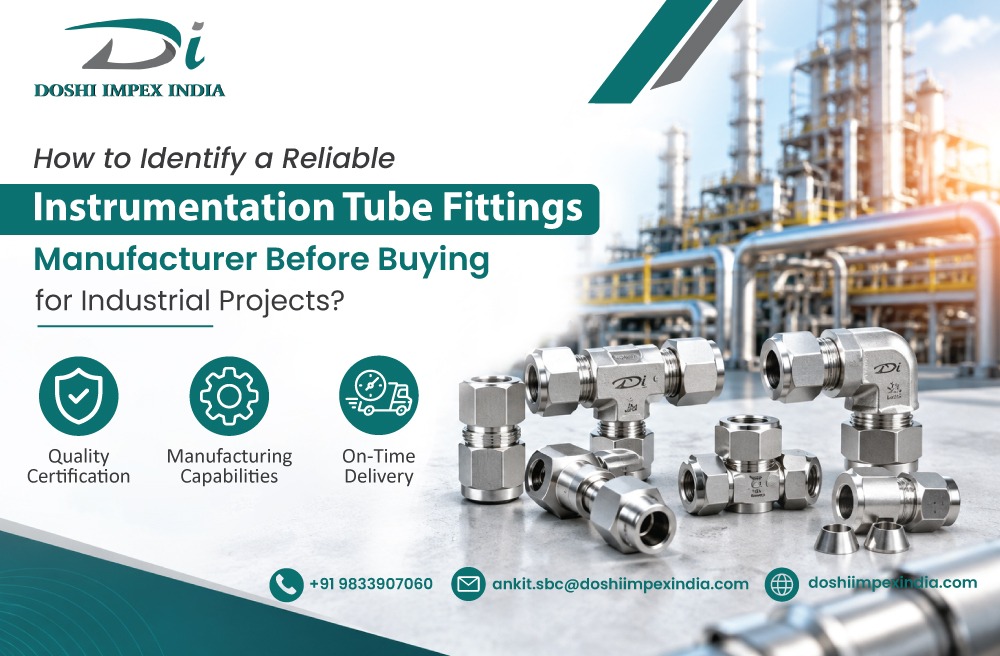
Industrial projects depend on thousands of components working together safely and consistently. Among these, instrumentation tube fittings play a critical role in connecting tubing used for measurement, control, and process instrumentation. A poor-quality fitting can result in leakage, pressure loss, inaccurate instrumentation, costly downtime, or even safety hazards.
Therefore, choosing the right instrumentation tube fittings manufacturer is not simply a purchasing decision—it is an important part of project risk management. But how can buyers identify a dependable manufacturer before placing an order?
What Are Instrumentation Tube Fittings?
Instrumentation tube fittings are precision-engineered components used to connect, terminate, redirect, or isolate tubing in instrumentation and process systems. They are commonly used in industries such as oil and gas, petrochemicals, chemicals, power generation, pharmaceuticals, refineries, and process engineering.
Common types include:
- Tube compression fittings
- Double ferrule fittings
- Single ferrule fittings
- Tube unions
- Tube elbows
- Tube tees
- Tube crosses
- Tube adapters
- Bulkhead fittings
- Tube connectors
- Instrumentation valves and related components
Because these fittings may operate under demanding pressure, temperature, and corrosive conditions, dimensional accuracy, material quality, surface finish, and manufacturing consistency are extremely important.
Why Is Choosing the Right Manufacturer Important?
The quality of instrumentation tube fittings directly influences the reliability of an instrumentation system. Even a small manufacturing defect can become a major operational problem when fittings are installed in high-pressure or critical process applications.
A reliable manufacturer should provide products manufactured according to applicable specifications and customer requirements. Consistent quality can help reduce leakage risks, installation problems, maintenance requirements, and premature component failure.
For industrial projects, working with an established instrumentation tube fittings supplier in India can also simplify procurement, documentation, customization, and repeat orders.
Who Should You Trust as an Instrumentation Tube Fittings Manufacturer?
Before buying, investigate the manufacturer’s technical and manufacturing capabilities rather than relying only on pricing.
A dependable manufacturer should be able to clearly answer questions about:
- Manufacturing capability:
Does the company manufacture the fittings or primarily trade products sourced from other suppliers? - Material selection:
Can the manufacturer supply appropriate materials such as stainless steel, carbon steel, alloy steel, or other materials required for the application? - Quality control:
Does the company have documented inspection and testing procedures? - Technical expertise:
Can its team understand tube sizes, pressure ratings, connection types, material requirements, and project specifications? - Documentation:
Can the manufacturer provide material certificates, inspection reports, test certificates, dimensional reports, and other documentation when required?
These questions help separate a genuine industrial manufacturer from a supplier that may not have sufficient technical control over its products.
When Should You Evaluate the Manufacturer?
Do not wait until the purchase order is ready to evaluate a supplier. Manufacturer qualification should ideally begin during the vendor-selection or engineering stage.
For large EPC and industrial projects, buyers should evaluate potential suppliers before finalizing the approved vendor list. This gives procurement teams enough time to verify manufacturing capabilities, quality systems, product specifications, delivery capabilities, and references.
Early evaluation is particularly important for projects involving large quantities, customized fittings, stringent specifications, or critical instrumentation systems.
Where Can You Find a Reliable Instrumentation Tube Fittings Manufacturer in India?
India has a large ecosystem of manufacturers and industrial suppliers serving domestic and international markets. However, geographical proximity alone should not determine supplier selection.
When searching for an instrumentation tube fittings manufacturer in India, examine the company’s manufacturing location, product range, technical capabilities, quality processes, industry experience, and ability to supply the required specifications.
Buyers should also assess whether the supplier can support projects beyond a single transaction. A dependable instrumentation tube fittings supplier in India should ideally be capable of handling repeat requirements, project documentation, technical queries, and consistent product quality.
How Can You Identify a Reliable Manufacturer Before Buying?
Here is a practical checklist for industrial procurement teams.
1. Verify Product Specifications
Check whether the manufacturer clearly specifies tube sizes, connection configurations, pressure ratings, material grades, dimensions, and applicable standards.
Avoid suppliers that provide vague descriptions without sufficient technical information.
2. Check Material Traceability
Material traceability is particularly important for critical industrial applications. Ask whether the supplier can provide appropriate material test certificates and traceability documentation.
The documentation should correspond to the actual material supplied wherever project requirements call for it.
3. Examine Quality-Control Procedures
Ask how incoming raw materials, machining operations, dimensions, threads, surface finish, assembly, and final products are inspected.
A serious manufacturer should have defined quality-control checkpoints rather than relying entirely on final visual inspection.
4. Evaluate Manufacturing Precision
Instrumentation fittings require accurate machining and reliable sealing surfaces. Ask about machining capabilities, dimensional inspection, ferrule performance, thread quality, and leak testing where applicable.
Precision is one of the most important indicators of a competent instrumentation fitting manufacturer.
5. Review Certifications and Documentation
Depending on the project, documentation may include material certificates, inspection reports, test certificates, certificates of conformity, and quality-management certifications.
Always verify that documentation matches the actual product and project requirements.
6. Assess Industry Experience
Experience matters because different industries have different operating conditions and procurement requirements. A manufacturer familiar with oil and gas, chemical processing, power, pharmaceuticals, or other process industries is more likely to understand application-specific expectations.
7. Compare More Than Price
The cheapest fitting is not necessarily the most economical option. Consider total cost, including installation, leakage risk, maintenance, replacement, downtime, documentation, and delivery reliability.
A manufacturer offering consistent quality and technical support can provide greater long-term value than a supplier competing solely on price.
8. Check Delivery Capability
Industrial projects often operate according to strict construction schedules. Ask about production capacity, standard lead times, stock availability, packaging, and dispatch procedures before placing the order.
9. Request Samples When Appropriate
For critical or unfamiliar suppliers, sample evaluation can help buyers assess dimensions, finish, workmanship, markings, packaging, and documentation before committing to a larger order.
10. Evaluate Communication and Technical Support
A reliable manufacturer should respond clearly to technical questions and commercial requirements. Prompt communication, accurate quotations, transparent specifications, and proper documentation are strong indicators of professional project support.
Doshi Impex India: Choosing Instrumentation Tube Fittings With Confidence
For industrial buyers, selecting an instrumentation tube fittings manufacturer should be based on quality, engineering capability, material reliability, documentation, consistency, and service—not price alone.
Doshi Impex India focuses on serving industrial requirements where dependable fittings and accurate specifications are essential. Buyers evaluating instrumentation tube fittings should clearly define their application, material, dimensions, pressure requirements, connection type, standards, quantity, and documentation requirements before placing an order.
A systematic supplier-evaluation process helps procurement teams minimize risk and select fittings that are suitable for demanding industrial applications.
Finding a reliable instrumentation tube fittings manufacturer in India requires more than searching for a supplier and comparing quotations. Industrial buyers should evaluate what the manufacturer supplies, why quality matters, who is capable of meeting the technical requirements, when supplier evaluation should happen, where the products are manufactured, and how quality and reliability are demonstrated.
By checking specifications, material traceability, manufacturing precision, quality systems, certifications, experience, delivery capabilities, and technical support, industrial projects can make more informed purchasing decisions.
For critical instrumentation systems, the right supplier is not merely the one offering a competitive price—it is the one capable of consistently delivering the right product, right quality, right documentation, and right support.
Get in touch with us at Doshi Impex India today to buy Instrumentation Tube Fittings in India of Premium Quality at an affordable Instrumentation Tube Fittings Price in India
1. How do I choose a reliable instrumentation tube fittings manufacturer?
Evaluate the manufacturer’s product specifications, material quality, traceability, manufacturing capabilities, inspection procedures, certifications, industry experience, delivery performance, and technical support before purchasing.
2. What should I check before buying instrumentation tube fittings in India?
Check the required material grade, tube size, connection type, pressure rating, dimensions, applicable standards, testing requirements, certifications, documentation, quantity, and delivery schedule.
3. Why is material traceability important for instrumentation tube fittings?
Material traceability helps buyers verify that the supplied fittings are manufactured from the specified material and provides important documentation for quality assurance and project records.
4. How can I verify an instrumentation tube fittings supplier in India?
Review its manufacturing and quality capabilities, technical documentation, product range, industry experience, customer support, certifications, and ability to meet project-specific requirements.
5. Why should industrial projects buy from an experienced instrumentation tube fittings manufacturer?
An experienced manufacturer is more likely to understand demanding industrial applications, maintain consistent manufacturing quality, provide appropriate documentation, and support customers with technical and project-specific requirements.