


 Call +91 9833907060
 Send E-mail
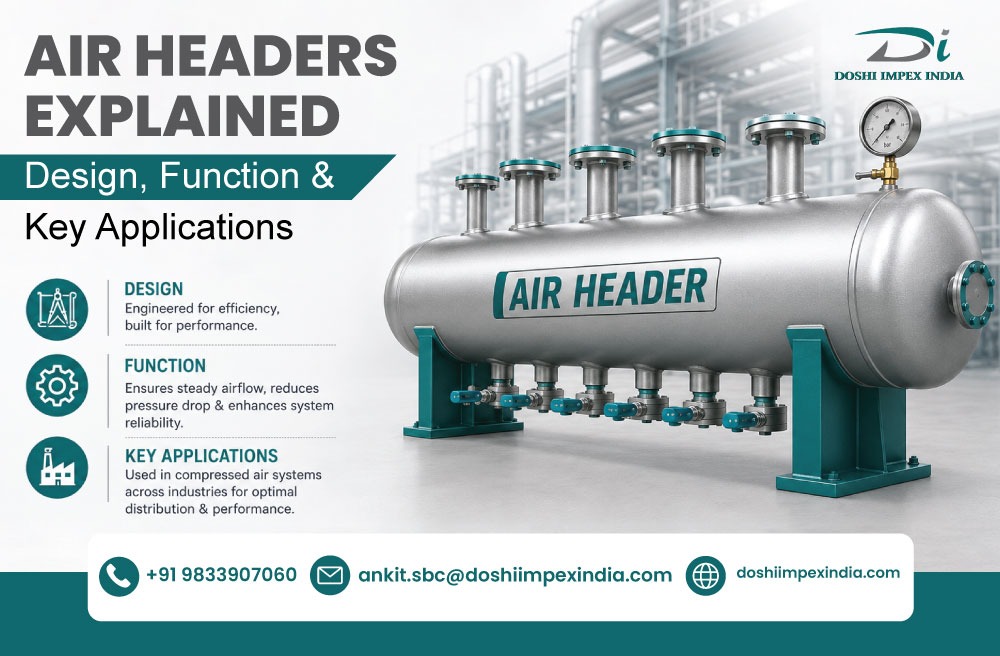
An air header is a vital element in industrial compressed-air and distribution systems for instrument air. It serves as an important central distribution point, accepting compressed air coming from a source and then supplying it to several downstream lines and equipment, instruments, as well as process equipment. Air headers that are properly designed aid in maintaining a constant pressure, increase efficiency in operation, and facilitate maintenance for industrial installations.
For businesses like petroleum and gas production, petroleum petrochemicals, pharmaceuticals, chemical energy generation, steel and manufacturing, dependable air distribution is crucial. Doshi Impex India offers high-quality air distribution systems that are designed to meet a variety of industrial needs. Understanding the functions, design of materials, the functions, and uses of an air header will assist companies in choosing the most suitable solution for their needs.
What Is an Air Header?
Air headers are an enormous pipe or manifold that is used to transport the compressed air coming from one central location to smaller outlets. It typically has multiple branches and drains, valves, and fittings that permit air to be efficiently distributed across a plant.
The Air Manifold serves the same purpose but on a smaller scale. While an air header can typically be used to distribute air across a plant, the air manifold is able to provide air to a variety of instruments, machines, equipment, or even specific processes.
Based on the purpose, an air header may be made with several outlets. It can be equipped with threaded or weld connectors, isolation valves, drainage arrangements, pressure gauges, and many other components.
How Does an Air Header Work?
The fundamental working principle behind an air header is simple. Air compressed through an air compressor or pumped via central air systems enters the header’s main entrance. The header distributes the air via multiple branch connections.
Each outlet is connected to an instrument, pipeline pneumatic actuator, or other equipment. Isolation valves permit individual outlets to shut down for maintenance, without having to interrupt the whole ventilation system.
An air manifold that has Valves can provide additional control by adding valves at each outlet point. This arrangement makes it simpler to separate sections, control flow when needed, and also perform maintenance safely.
Instrument Air Header: Importance in Process Industries
A Header for an instrument is specially designed to supply dry, clean, and robust compressed air to the pneumatic equipment as well as control devices. Instrument air is commonly employed for control valves, pneumatic actuators, positioners and control systems, and various other equipment for automation.
Since pneumatic instruments are sensitive to oil, moisture, and other pollutants, instrument-air systems must be equipped with proper air filtration and filtration before distribution. The header should also be constructed to ensure the proper pressure under various operating conditions.
An appropriately designed instrument air header ensures reliability in pneumatic control systems. It also reduces the chance of interruptions due to inadequate quality of the air, or on account of contamination.
Key Design Considerations for Air Headers
A variety of factors must be taken into consideration when deciding on the air header to use:
1. Operating Pressure
The header should be appropriate to the system’s maximum operating pressure. The design pressure, the test pressure, as well as safety requirements must be assessed before construction.
2. Material Selection
The selection of materials is based on operating conditions, the temperature, pressure, and corrosion exposure. The requirements of the industry. Steels made of carbon and stainless steel are typically considered for use in industrial settings, and specialized materials can be chosen for harsh environments.
3. Header Size
The header’s diameter must be able to accommodate the necessary airflow without causing an excessive loss of pressure. A header that is too small can lead to poor performance, particularly if multiple outlets are running simultaneously.
4. Number and Position of Outlets
Outlet connections should be set in accordance with the layout of your plant and downstream specifications. Proper spacing will simplify maintenance and installation while minimising the need for piping.
5. Valves and Isolation
Individual isolation valves can be useful to control different branches. An air manifold that has Valves will provide efficient control when multiple connections require separate isolation.
6. Drain Arrangement
Moisture can build up in compressed-air systems. The right drain points and low-point configurations can eliminate condensate as well as protect downstream equipment.
Major Applications of Air Headers
Air headers are employed in an array of industries. They are used in a variety of ways, including:
- Plants for processing oil and gas
- Chemical and Petrochemical industries
- Refineries
- Power generation plants
- Processing facilities for metals and steel
- Manufacturing of pharmaceuticals
- Food processing plants
- Manufacturing and engineering units
- Systems for pneumatic automation
- Control and instrumentation systems
In these instances, air headers are an organized and centralized method of providing compressed air or instrument air to various points.
Advantages of Using an Air Header:
A properly designed air header can provide numerous operational benefits. It helps create a well-organized distribution system and reduces the complexity of connections to the source of compressed air. Multiple outlets enable multiple instruments or machines to take an air supply from the exact distribution source.
Air headers are also easier to maintain, as each branch can be separated by using appropriate valves. The proper size can reduce pressure drop and ensure steady operation.
Large industrial facilities’ central distribution can enhance system organization, facilitate future expansion, and make troubleshooting efficient.
Choosing an Air Header Manufacturer in India
Selecting the best manufacturers of Air Headers from India is crucial to ensure product reliability and compatibility with the desired application. Buyers must consider the quality of the material and fabrication standards, as well as the precision of dimensional measurements and outlet configuration, pressure requirements and valve selection, as well as the finishing of the surface and the inspection specifications.
A reputable manufacturer or supplier should also know the process requirements of the customer and offer an air header that is suitable for the particular application, rather than providing a single-size solution.
Doshi Impex India is a company that provides industrial equipment and custom solutions for a variety of engineering applications. Customers can discuss the required dimensions of materials and outlet configurations, pressure ratings, as well as other specifications before deciding on their specifications.
Air Header Price in India
The price of an air header in India differs based on various factors, such as the quality of the material, header length, diameter, as well as the number of outlets. Pressure rating and fabrication specifications, valve configuration, and the possibility of customization.
The air headers made of stainless steel like those mentioned above can differ in price compared to carbon steel designs due to variations in the cost of materials and the manufacturing specifications. Also, an air header fitted with multiple valves as well as special fittings could be more expensive than a standard header.
To get a precise quote, customers should supply specifications including the size, material, operating pressure, outlet number, type of connection, and quantity. Doshi Impex India can assist customers in assessing their needs and choosing the most suitable configuration.
A header for air is more than a pipe segment; it’s an essential component of a well-functioning compressed-air and instrumentation system. From distribution of plant air to providing pneumatic control equipment, a well-designed header will ensure reliable and efficient industrial processes.
You may require the use of an air manifold, an air manifold with valves, or an instrument air header; choosing the appropriate dimensions, material, pressure rating, and outlet configuration is crucial. For companies looking for an experienced manufacturer of Air Headers in India are able to seek out Doshi Impex India for requirements that are specific to the application and solutions that are competitive.
1. What exactly is an Air Header employed to do?
A header for air is used to disperse compressed air coming from one central point to various downstream equipment, instruments, pneumatic systems, and process lines.
2. What’s the distinction between an Air Header and an Air Manifold?
A manifold is typically utilized for larger, central compressed-air distribution. An air manifold is typically used to distribute air to multiple devices or outlets.
3. What exactly is the definition of an Air Manifold with Valves?
The Air Manifold with Valves is an air distribution system that is equipped with distinct valves at the outlet connections. The valves permit separate branches to be controlled or isolated during operation and maintenance.
4. What are the factors that affect the Air Header Price in India?
Air Header Cost in India depends on the type of material, size, shape of the head, pressure rating, number of outlets and valve configurations, connection type, requirements for fabrication, and the possibility of customization.
5. How do I select the best Air Header Manufacturing Company in India?
Choose a manufacturer or a supplier according to the quality of their products and material choices, fabrication capabilities, dimensional precision, pressure requirements, the possibility of customization, inspection facilities, as well as after-sales assistance.